Why Mental Health Issues Affect Your Work Performance
You used to be good at your job. You know you are.
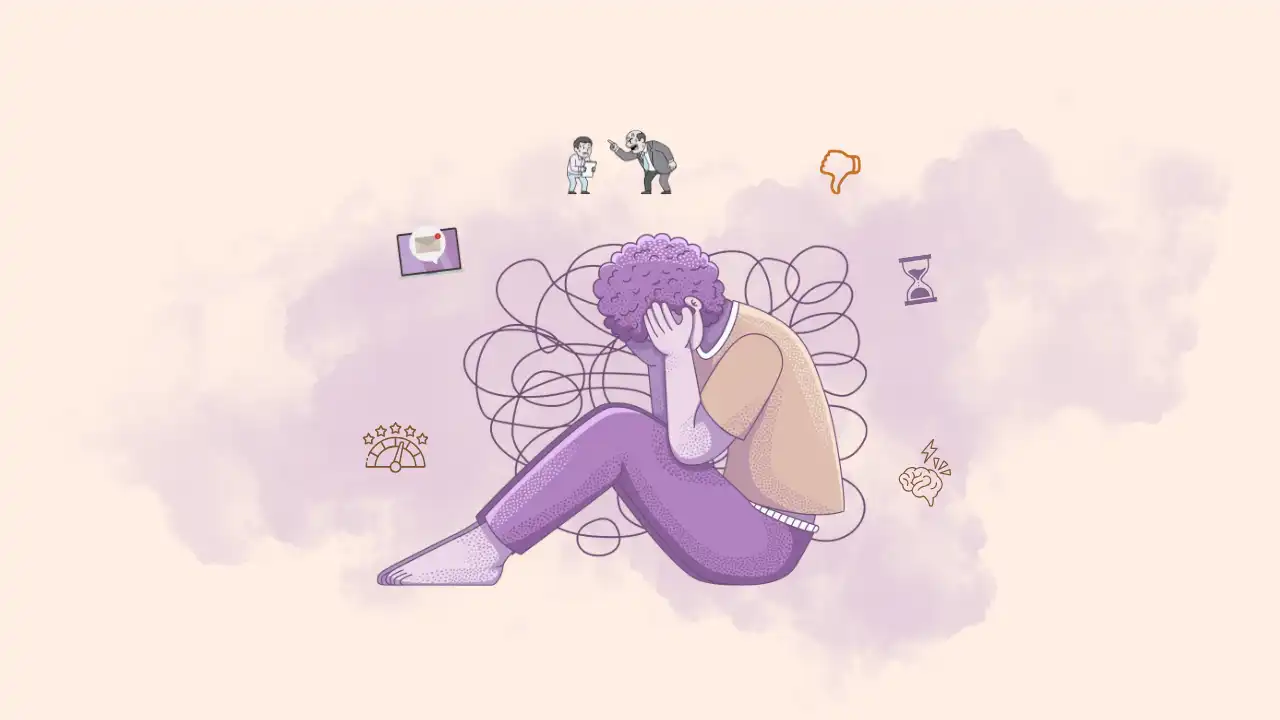
But lately something has shifted.You sit down to work and an hour just disappears. Your mind goes blank in meetings. You send a simple email and then spend thirty minutes picking it apart. And no matter how much you sleep, the exhaustion just does not go away.
And the part that makes it worse is that from the outside, everything probably looks fine. You are showing up. You are getting through the day. Nobody has said anything yet.
But you know something is off. And you have been waiting for it to sort itself out for longer than you want to admit.
Here is what most people do not realize. What you are describing is not a work problem. It is a mental health problem that is showing up at work. And those two things need very different responses.
What Is Really Behind Your Struggling Work Performance
When your mental health is under strain, the first things to go are the ones your job depends on most. Focus, memory, decision making, and the ability to push through when things get hard. If your work performance has been slipping and you cannot figure out why, the answer might not be about your job at all. It might be about what is happening inside your brain. Addressing the root cause is what actually moves the needle, not pushing harder through something that was never a productivity problem to begin with.
Your Brain Is the Tool You Work With
Every job, no matter what it involves, runs on your brain. Your concentration, your memory, your ability to make decisions, manage relationships, handle pressure, and keep going when things get hard. All of that is cognitive and emotional function.
When your mental health is struggling, those functions take the hit first.
Work performance does not decline because you stopped caring or because you are not trying hard enough. It declines because the part of you that drives focus, motivation, and clear thinking is under strain. That is not a character flaw. That is biology.
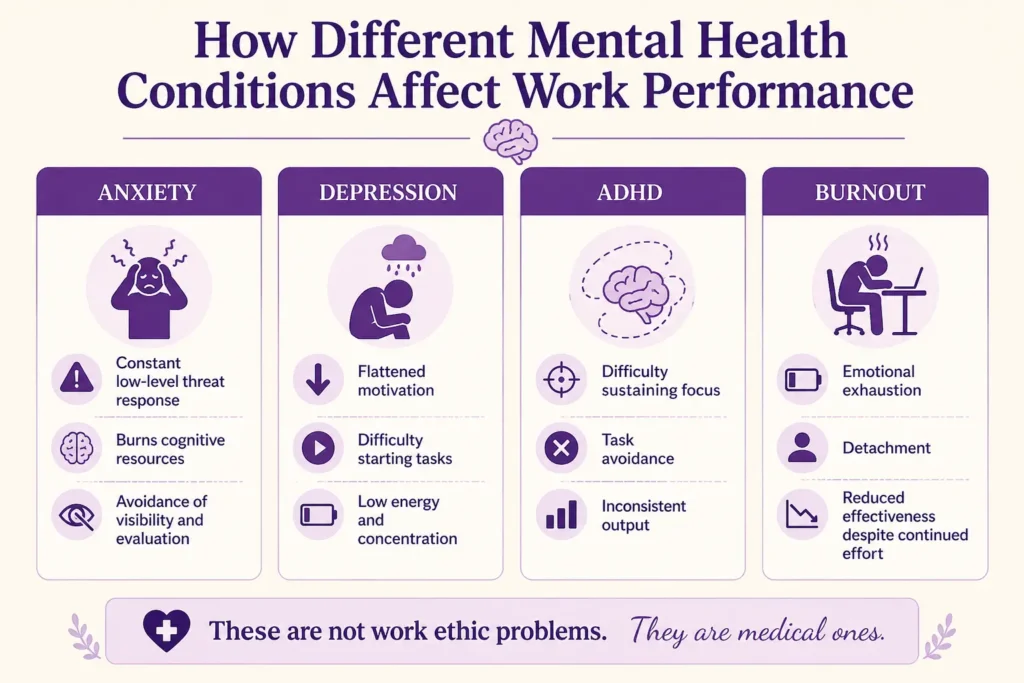
Anxiety keeps your nervous system in a low-level threat response all day, which burns through your cognitive resources before you have done anything productive. Depression flattens the motivation and reward circuits that make it possible to start tasks and feel satisfied when you finish them. ADHD, especially when undiagnosed or untreated, makes sustained focus feel genuinely impossible regardless of how much you want to concentrate.
None of these are willpower problems. They are medical ones.
Is Brain Fog at Work the Symptom Nobody Takes Seriously
If you have been experiencing brain fog at work, you already know how frustrating it is to try to explain to someone who has not felt it.
This is not about being tired. You walk into a conversation and the words you needed three seconds ago are just gone. Reading the same sentence four times and nothing sticks. You sit in front of work you actually know how to do and your brain just refuses to move.
Brain fog at work shows up across a range of mental health conditions. Anxiety, depression, ADHD, sleep disorders, and chronic stress can all produce it. So can some psychiatric medications, which is worth mentioning to your provider if you notice a change after starting something new.
The reason brain fog matters beyond the frustration of it is that it is one of the first signs your mental health needs attention. A lot of people chalk it up to getting older, being busy, or needing more coffee. Sometimes it is those things. But when it is persistent and it is affecting your ability to function at work, it is worth taking seriously.
ADHD at Work Symptoms That Often Get Missed
A significant number of adults working full-time have ADHD that was never diagnosed. They spent their whole school years and early careers developing workarounds, and at some point, those workarounds stopped being enough.
ADHD at work symptoms in adults do not always look like a child who cannot sit still. They look like a high-functioning professional who struggles enormously to start tasks, especially ones that feel bored even if they are important. You only really get moving when a deadline is right on top of you. Conversations slip away mid-meeting without you even noticing. And there are seventeen browser tabs open that you cannot explain.
They also look like someone who is working significantly harder than their colleagues to produce the same output, which over time creates a particular kind of exhaustion that goes beyond normal work tiredness.
If any of that sounds familiar, an ADHD evaluation is a reasonable next step. Treated ADHD looks dramatically different from untreated ADHD when it comes to work performance. It is one of the most treatment-responsive conditions in psychiatry.
Social Anxiety at Work and Performance Anxiety at Work
These two sit close together, and they both quietly wreck work performance in ways that are hard to put your finger on.
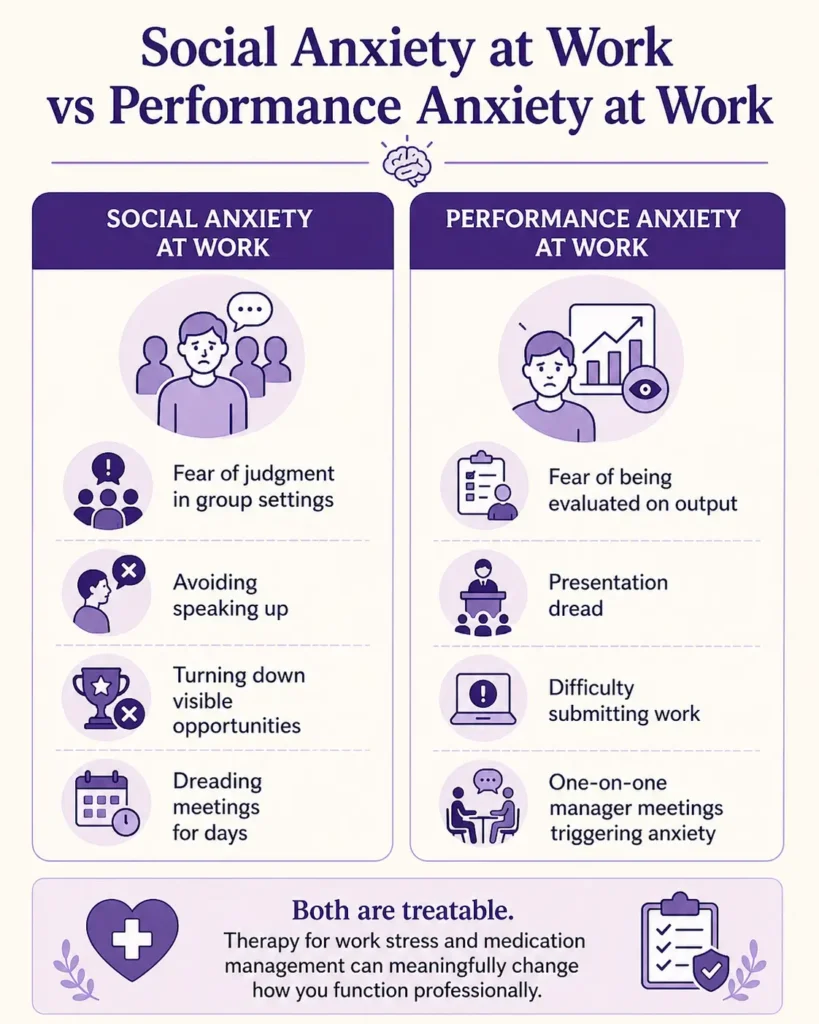
Social anxiety at work is not just being a little shy. Team meetings feel like something to survive, not attend. You know the answer in the room but say nothing because the risk of being wrong in front of everyone feels too big. Career opportunities that could actually mean something get passed up because they put you in the spotlight.
Performance anxiety at work is slightly different. It is specifically the fear of being evaluated or judged. Presentations trigger it most obviously, but it can show up in one-on-one meetings with a manager, in written work you are terrified to submit, in any situation where someone is going to assess what you produced.
Both of these are treatable. Therapy for work stress that includes cognitive behavioral therapy has strong evidence for both social anxiety and performance anxiety. Learning how to calm anxiety at work is a real skill that can be taught, and most people who pursue proper treatment see meaningful improvement in how they function professionally.
Is Imposter Syndrome at Work Really Just Self-Doubt
Most people have heard of imposter syndrome at work. That persistent feeling that you do not deserve the position you are in, that you are one bad presentation away from being found out, that everyone around you is more competent than you even when the evidence clearly says otherwise.
For a lot of people, imposter syndrome is a manageable background hum. For others it is genuinely debilitating, and in those cases, it is often sitting on top of an anxiety disorder or depression rather than being a standalone confidence issue.
Leadership and mental health intersect here in a particular way. Senior professionals and leaders are some of the least likely to seek mental health support, partly because the role requires projecting confidence and partly because asking for help can feel incompatible with how they see themselves professionally. But leadership and mental health are not separate concerns. Untreated anxiety, depression, or burnout in a leadership role affects not just the individual but everyone they manage.
If imposter syndrome is driving decisions you make about your career, your team, or how much you take on, it is worth exploring with a professional whether what you are experiencing is more than ordinary self-doubt.
Why Is Calling in Sick for Mental Health Still So Hard to Justify
A lot of people will take a sick day for a migraine without thinking twice but will drag themselves into work through a panic attack because calling in sick for mental health feels harder to justify.
That disconnect is worth naming. Your mental health is part of your health. A day where you are so anxious you cannot string a sentence together or so depressed you cannot get off the sofa is not less valid than a day when you have a fever.
Taking a mental health day is not a weakness and it is not taking advantage of your employer. It is recognizing that you need a day to stabilize before you make mistakes, say something you cannot take back, or push yourself into a worse state.
According to the American Institute of Stress, workplace stress costs US employers an estimated 300 billion dollars annually through absenteeism, reduced productivity, and employee turnover. A managed mental health day is almost always less costly than the alternative.
What Are You Actually Entitled to With Mental Health Leave from Work
If your mental health has reached a point where a day or two is not enough, knowing your rights matters.
Mental health leave from work in the US is protected under several frameworks. The Family and Medical Leave Act covers unpaid leave for serious health conditions including mental health conditions, for eligible employees at covered employers. Short term disability mental health coverage varies by policy, but many employer-provided disability plans do cover psychiatric conditions. Your HR department or your benefits provider can tell you what your specific plan includes.
ADA mental health accommodations are another avenue worth knowing about. The Americans with Disabilities Act requires employers with 15 or more employees to provide reasonable accommodations for conditions that substantially limit major life activities. Mental health conditions including depression, anxiety, PTSD, and bipolar disorder can qualify.
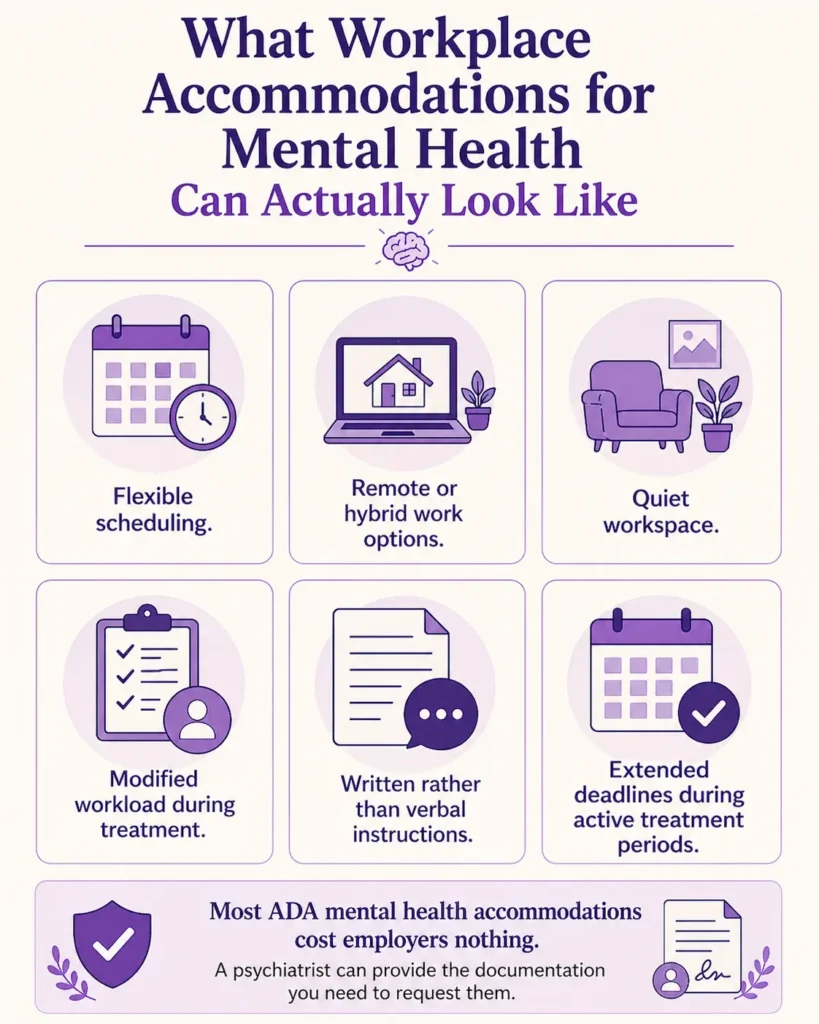
Workplace accommodations for mental health under the ADA might include flexible scheduling, the ability to work remotely some or all of the time, modified workload during treatment, or a quieter workspace. According to the Job Accommodation Network, the majority of workplace accommodations for mental health cost employers nothing at all.
You do not have to disclose your specific diagnosis to request accommodations. You need documentation from a licensed provider that you have a condition that affects your ability to perform certain functions, and that specific adjustments would help. A psychiatrist can provide that documentation.
Is Meditation for Work Stress Really Just One Tool Among Several
Meditation for work stress gets a lot of attention and it is genuinely useful for some people in some situations. Regular mindfulness practice does have evidence behind it for reducing cortisol, improving attention regulation, and lowering baseline anxiety.
But it is worth being honest about what meditation can and cannot do. It is a tool, not a treatment. For mild to moderate work-related stress, a consistent mindfulness practice can meaningfully shift how you respond to pressure. For someone dealing with untreated ADHD, a clinical anxiety disorder, or depression, meditation alone is not going to be enough.
The most effective approach to work performance issues driven by mental health is usually a combination of health. Therapy for work stress that addresses the specific patterns driving your difficulties. Medication management when appropriate. Practical tools like mindfulness, exercise, and sleep hygiene support the treatment rather than replace it.
FAQs
It hits the parts of your brain you rely on most. Focus, memory, decision making, and motivation all start slipping when your mental health is under strain. What looks like a work performance problem on the outside is often a mental health problem that has not been addressed yet.
It rarely looks like someone who cannot sit still. It looks like someone working twice as hard as everyone else just to keep up. Starting tasks feels impossible, conversations slip away mid-meeting, and deadlines are the only thing that ever creates enough urgency to actually get moving.
A well-timed mental health day can stop a bad week from becoming a bad month. It is not avoidance. It is recognizing that pushing through when your brain is already at its limit usually makes things worse, not better. The key is knowing when rest is enough and when treatment is what you actually need.
More than most people realize. Flexible hours, remote work, a quieter space, a modified workload during treatment. You do not have to share your diagnosis. You just need a licensed provider to document that certain adjustments would help you do your job.
When a few days off stops being enough and you are still struggling to function week after week, that is the signal. Mental health leave from work exists for exactly this situation. Short term disability mental health coverage may apply depending on your plan, and it is worth finding out before things get harder.
When to Actually Get Help
There is a version of this where you keep trying to manage it yourself, and things gradually get harder. And there is a version where you get a proper evaluation, find out what is driving the difficulties you are having at work, and start feeling like yourself again.
The second version is available to you.
Work performance has been off for weeks and it is not just a rough patch. Your work performance has been off for weeks and it is not just a rough patch. Opportunities feel too risky to take. You are working harder than ever and getting less back. If ADHD, anxiety, or depression has ever crossed your mind, a proper evaluation is worth having.
At Beautiful Minds Psychiatry in Frisco, the team sees working adults dealing with these kinds of concerns. A thorough psychiatric evaluation is where that starts, followed by medication management and treatment planning built around your real life, including your work demands and schedule.
Telehealth appointments are available for people who cannot easily take time away from work for in-person visits. For patients whose depression or anxiety has not responded to standard treatments, TMS therapy and Spravato are also available at the practice.
Disclaimer: This content is for informational and educational purposes only. It is not a substitute for professional mental health advice, diagnosis, or treatment. If you are in crisis, call or text 988 for the Suicide and Crisis Lifeline.