Social Anxiety in the Workplace: Why High-Achieving DFW Professionals Suffer in Silence
There is a specific kind of dread that hits Sunday night. Not the general “I do not want to go to work tomorrow” feeling that most people brush off. This is something heavier. Running through tomorrow’s meetings in your head, rehearsing what you might say, imagining what could go wrong, and lying awake at 1 a.m. still not feeling ready. Monday morning hits and you are already worn out before a single thing has happened.
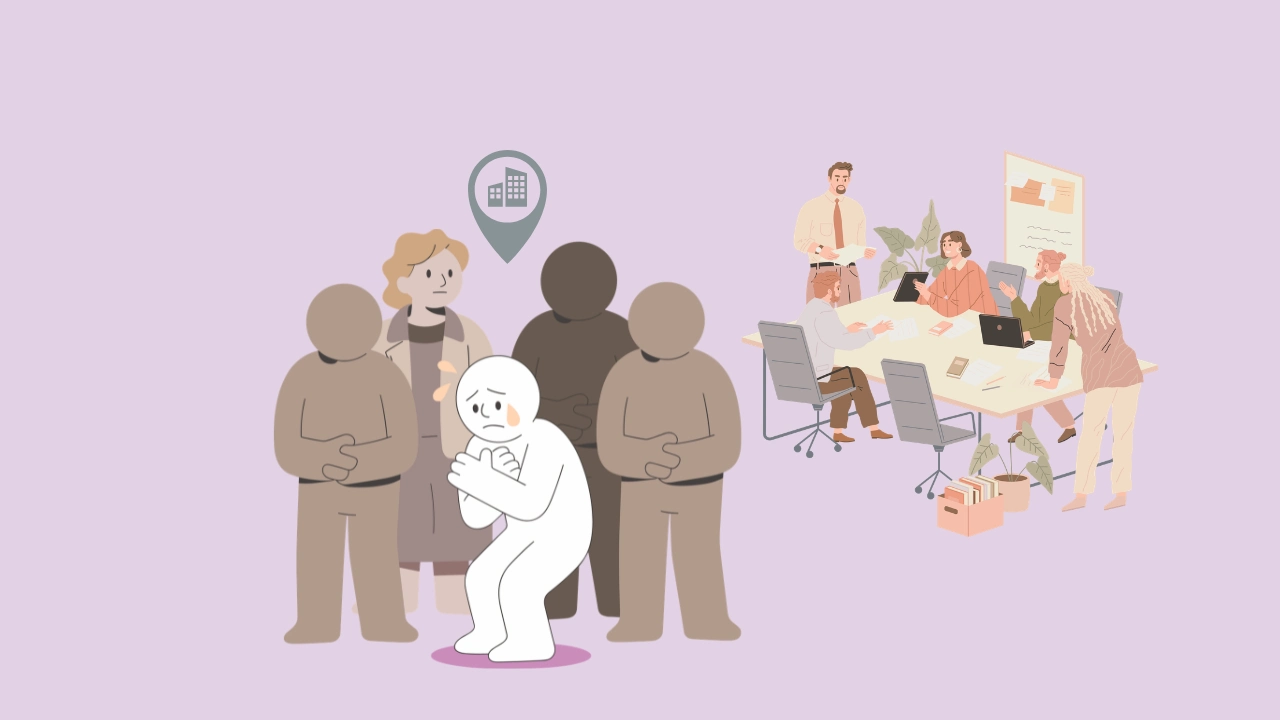
For a lot of high-achieving professionals across Dallas, Frisco, Plano, and the wider DFW area, that is not an occasional bad night. That is every single week. From the outside, nothing looks wrong. You walk in, say what you need to say, and get through it. Nobody in that room has any idea what it took to get there. Nobody would guess that your heart is pounding the entire time, your mind is scanning the room for judgment, and part of you is counting the minutes until it is over.
Social anxiety in the workplace does not always look like struggle. Sometimes it looks like the most polished person in the room, quietly falling apart on the inside.
Key Takeaway:
- Why social anxiety vs shyness is not the same thing
- Why that difference matters
- What social anxiety at work looks like in high achievers
- How anxiety and cortisol levels create real physical symptoms that are hard to hide
- Why SSRIs for social anxiety and online therapy for social anxiety are changing
- What treatment looks like
- Where DFW professionals can find real support without it affecting their careers
The Difference Between Social Anxiety And Everyday Nervousness
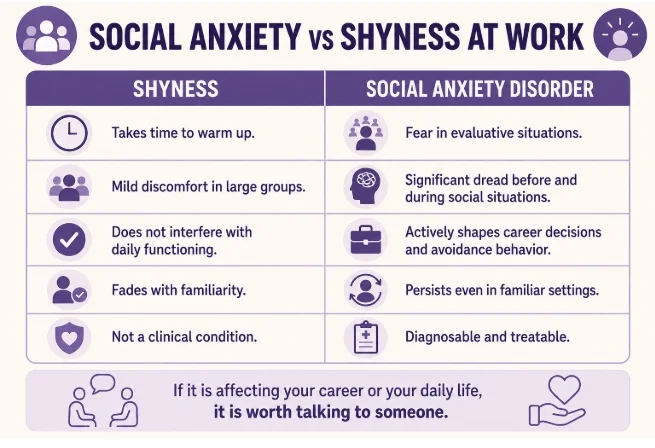
Before anything else, it is worth clearing up the confusion between social anxiety vs shyness because they are not the same thing, and treating them as interchangeable causes a lot of people to dismiss what they are actually dealing with.
Shyness is a personality trait. Some people are naturally more reserved, take longer to warm up new people, or prefer smaller settings. That is normal and does not interfere with daily life in any significant way.
Social anxiety disorders are different. According to the National Institute of Mental Health, it is a clinical condition where social situations trigger a fear of response that is intense, persistent, and difficult to control. National Institute of Mental Health: Fear is not about being shy. Someone is always watching, judging, and finding you short of the mark.
Social anxiety at work shows up hardest in situations where your performance or judgment is on the line. Presenting a group. Asking a question in a meeting and wondering if it sounds stupid. Sending an email and rereading it five times before hitting send. Getting feedback from a manager and spending the rest of the day dissecting every word. These are not quirks or insecurities. For someone with social anxiety disorder, they are genuinely distressing and take up enormous amounts of mental energy.
The high-achieving part adds another layer of complexity. A lot of professionals with social anxiety have built entire careers around managing it. They rehearse everything before it happens. Every word, every possible response, every way the conversation could go. And still, they show up looking completely put together, because falling short in front of someone else feels unbearable. That strategy works well enough to keep moving forward professionally, but it is completely exhausting. And it tends to work until it does not.
Why High Achievers Suffer in Silence
There is a specific reason why social anxiety in the workplace stays hidden in high-performing professionals for so long, and it comes down to the fact that the coping strategies that anxiety drives look like ambition from the outside.
Overpreparing for every meeting looks like dedication. Avoiding situations where you might be put on the spot looks like you’re being selective with your time. Staying quiet in group settings and letting others take the lead looks like being a good listener. Volunteering for solo projects instead of collaborative ones looks like someone who works well independently. None of those things raise flags. In a lot of workplace cultures, they get rewarded.
The internal experience is entirely different. There’s always a reason behind the preparation, and that reason is the fear of being humiliated. The avoidance isn’t laziness or rudeness. A nervous system stuck in survival mode genuinely cannot tell the difference between a staff meeting and a real threat. That quiet person in the corner? They’re not relaxed. They’re holding everything together as tightly as they can, just hoping no one looks too closely.
Social anxiety and perfectionism are deeply connected in this group. The fear of being judged pushes people toward standards that are impossible to maintain, and when they inevitably fall short of those standards, it confirms the fear that they are not actually good enough. That loop runs quietly in the background of a lot of high-achieving careers, and it takes a real toll over time.
The Physical Side Nobody Mentions
One reason social anxiety at work is hard to shake is that it is not just a thought pattern. The physical side of it can make certain workplace situations feel completely unbearable.
Social anxiety and sweating is one of the most common and most embarrassing symptoms professionals deal with. You are about to present and your body responds as if something dangerous is happening. Palms get damp. Warmth creeps up your neck. The self-consciousness about it makes the anxiety worse, which makes the physical response worse. It becomes its own loop.
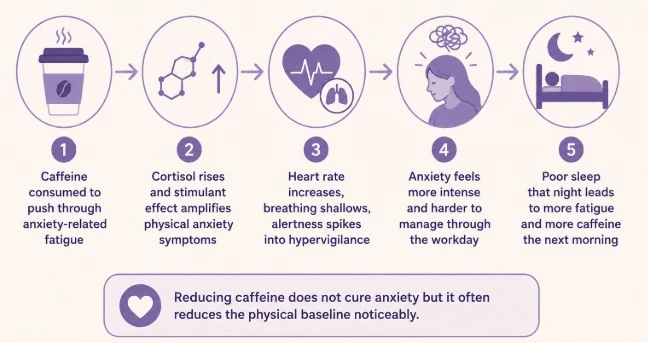
Anxiety and cortisol levels explain a lot of what is happening underneath. The American Psychological Association notes that cortisol is your body’s primary stress hormone, and when anxiety is chronic, it stays elevated in a way it was never designed to.
That sustained elevation hits sleep, concentration, digestion, and mood all at once. A professional managing workplace social anxiety for years without treatment is often running on a stress response that never fully resets, even when their performance reviews look perfectly fine.
Anxiety and caffeine sensitivity do not get enough attention. A lot of anxious professionals lean heavily on coffee to push through fatigue from poor sleep and chronic stress. Research from Harvard Health Publishing confirms that caffeine raises cortisol and amplifies the physical symptoms of anxiety already present. Cutting back is not a cure, but it often reduces the physical intensity in a way that is hard to ignore.
Other physical symptoms include a tight chest before meetings, nausea before presentations, difficulty concentrating when stakes feel high, and full-body fatigue that settles in after a day of holding everything together.
How It Shows Up Differently for DFW Professionals
The Dallas-Fort Worth professional culture has its own particular relationship with performance and image. DFW is home to a significant concentration of corporate headquarters, finance firms, healthcare organizations, and tech companies. The professional environment is competitive, image-conscious, and often places a high premium on confidence, presence, and visibility.
For someone managing social anxiety in the workplace in that environment, the pressure is compounded. Networking events are not optional extras in a lot of DFW industries. They are how relationships get built and how careers move forward. Visibility in meetings matters. Being known, being vocal, and being seen as leadership material is tied directly to how much you speak up and how composed you appear while doing it.
Social anxiety at work in that context is not just uncomfortable. It actively gets in the way of career growth in ways that are hard to explain to people who do not experience it. You know you are capable. You know your work is good. Getting yourself to take up space in the room in the way that gets you noticed is a different challenge entirely.
A lot of DFW professionals in this position describe watching less qualified colleagues advance faster simply because they were more comfortable being visible. That is a particular kind of frustration that adds its own weight to an already heavy situation.
What Treatment Actually Looks Like
Social anxiety disorder is one of the most treatable mental health conditions, but most people spend years managing it alone because they have convinced themselves it is just their personality.
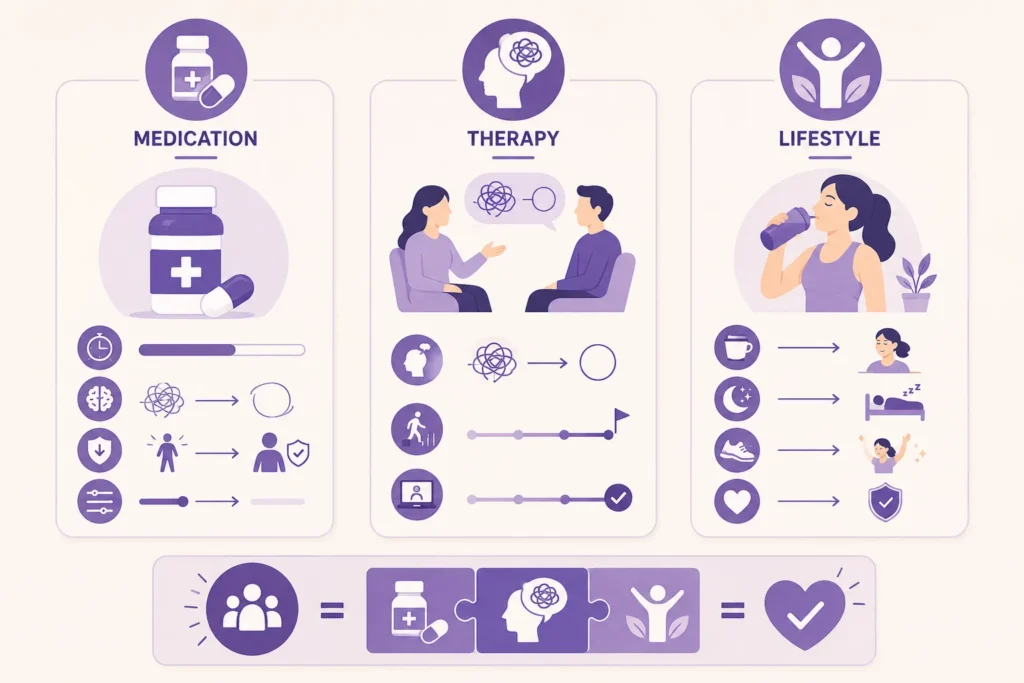
SSRIs for social anxiety work by increasing serotonin in the brain, which helps regulate the fear systems driving the anxiety. Medications like sertraline and escitalopram have strong evidence behind them. When the dose is right, most people describe the baseline threat their brain assigns to social situations dropping noticeably.
Anxiety treatment Dallas has grown significantly for working professionals who need care that fits a demanding schedule. Online therapy for social anxiety has made getting help genuinely realistic. A professional in Frisco or Plano can connect with a provider from anywhere private during a lunch break, no time off required.
Medication and therapy together produce stronger outcomes than either one alone. Cognitive behavioral therapy identifies the thought patterns feeding the fear and gradually builds real experience of social situations that went fine.
Frequently Asked Questions
Pretty effective for most people. Something usually shifts within the first two to four weeks, but the real difference shows up closer to six to eight weeks in. The goal is not to stop feeling nervous entirely. It is to bring things down enough that anxiety stops making decisions for you. Doses sometimes need adjusting, so staying honest with your provider early on matters a lot.
Start with your body before anything else. Feet flat on the floor, breathing slowed down, let that settle first. Your body is pulling your brain along in those moments, not the other way around. Knowing roughly what you want to say ahead of time takes a surprising amount of pressure off too.
Sleep at the same time every night, move your body every day, and pull back on caffeine. That is genuinely it. Not glamorous but it actually works when you stick with it consistently.
Absolutely. Caffeine turns the volume up on everything anxiety is already doing quietly in the background. For someone already running on edge, that first cup can be exactly what tips things over.
Find someone licensed who actually specializes in anxiety and uses cognitive behavioral therapy specifically, not just someone who lists it somewhere on their profile among twenty other things. The Anxiety and Depression Association of America has a therapist directory that is a solid place to start.
Getting Support at Beautiful Minds Behavioral Health
Beautiful Minds Behavioral Health in Frisco works with professionals across the DFW area who are dealing with social anxiety disorder, whether they are coming in with a clear picture of what is going on or just a sense that something has been making work harder than it should be for a long time.
The practice offers both telehealth and in-person appointments, which means getting evaluated and starting treatment does not require restructuring your workweek. Evaluations are thorough enough to distinguish social anxiety from generalized anxiety, depression, burnout, and other conditions that can overlap, because getting the right diagnosis is what makes treatment work.
If you have been delivering at a high level professionally while quietly managing something that takes far more out of you than anyone around you realizes, that is worth addressing. Performing well despite anxiety is not the same as being okay.
Disclaimer: This content is for informational and educational purposes only. It is not a substitute for professional mental health advice, diagnosis, or treatment. If you are in crisis, call or text 988 for the Suicide and Crisis Lifeline.