TMS Therapy in Frisco: What Does a Real Treatment Session Actually Feel Like?
Most people who investigate TMS therapy have already been through a lot of work. They have tried one antidepressant, then another, then maybe a third. A few helped for a while. Others did not help at all. In some cases, the symptoms actually got worse. By the time TMS services come up in the conversation, the question is rarely “Does this work?” It is more like, “What am I actually walking into, and is this going to be worth it?”
That is a fair question, and it deserves a straight answer. Not a brochure version, but an honest picture of what a real TMS session looks like, feels like, and what you can actually expect from the process to start to finish.
Key takeaway:
- What TMS services involve and what a real session feels like from start to finish
- How NeuroStar TMS, Brainsway TMS, and MagVenture TMS differ from each other
- Why TMS therapy success rate numbers matter before you commit to a full course
- What TMS contraindications exist and who may not qualify
- How TMS therapy insurance coverage works and what the authorization process looks like
- Where to get a proper TMS evaluation in the Frisco and DFW area
What TMS Actually Is
People in Dallas are asking more and more about transcranial magnetic stimulation. It’s a non-invasive treatment that uses magnetic pulses to stimulate the brain. It uses magnetic pulses to stimulate specific areas of the brain involved in mood regulation.
The pulses work by triggering electrical activity in brain cells, which, over a course of treatments, encourages the kind of neuroplasticity that depression disrupts. Think of it less like a jolt and more like a consistent, structured nudge that builds itself over time. According to the U.S. Food and Drug Administration, TMS received FDA clearance for major depressive disorder in 2008, and the evidence base has grown steadily since then.
What makes TMS different from medication is that it works locally rather than systemically. Antidepressants travel through your whole body and affect multiple systems along the way. TMS targets a specific region directly, which is a significant part of why it tends to have a cleaner side effect profile for most people.
The Different Types of TMS
Not all TMS devices work the same way, and understanding the differences helps set realistic expectations before your first session.
NeuroStar TMS stands as one of the most commonly used systems across the United States. It also has a long history of use in real clinical settings. It uses a figure-eight coil and delivers repetitive magnetic pulses to the left dorsolateral prefrontal cortex. Most standard NeuroStar TMS protocols run about 19 to 37 minutes per session, depending on the specific parameters used.
BrainsWay TMS works with a different coil design called an H-coil. That design allows the treatment to reach deeper parts of the brain, which is why people often call it deep TMS therapy. The H-coil reaches slightly deeper and broader brain regions compared to standard figure-eight coils. According to Brainsway Clinical Documentation, the system holds FDA clearance for both depression and OCD, making it a relevant option when TMS therapy for OCD is part of the clinical picture.
MagVenture TMS gives doctors flexible coil choices to work with. Clinics and research teams both use it in different settings. It supports theta burst stimulation protocols, which are a newer, faster way of delivering TMS that can bring session times down to as little as three minutes while producing comparable outcomes to longer standard protocols.
Your provider will determine which system and protocol fit your situation based on your diagnosis, history, and treatment goals.

What the First Appointment Actually Looks Like
Before the treatment starts, your provider first finds your motor threshold. This helps set the right level for the magnetic pulses. It shows how your brain responds so the treatment can be set just for you.
The provider sends a small series of pulses to your motor cortex, the part of the brain that controls hand movement. They slowly increase the intensity until your thumb twitches. That point becomes the reference for setting your treatment level. Most people find it a little strange but not painful.
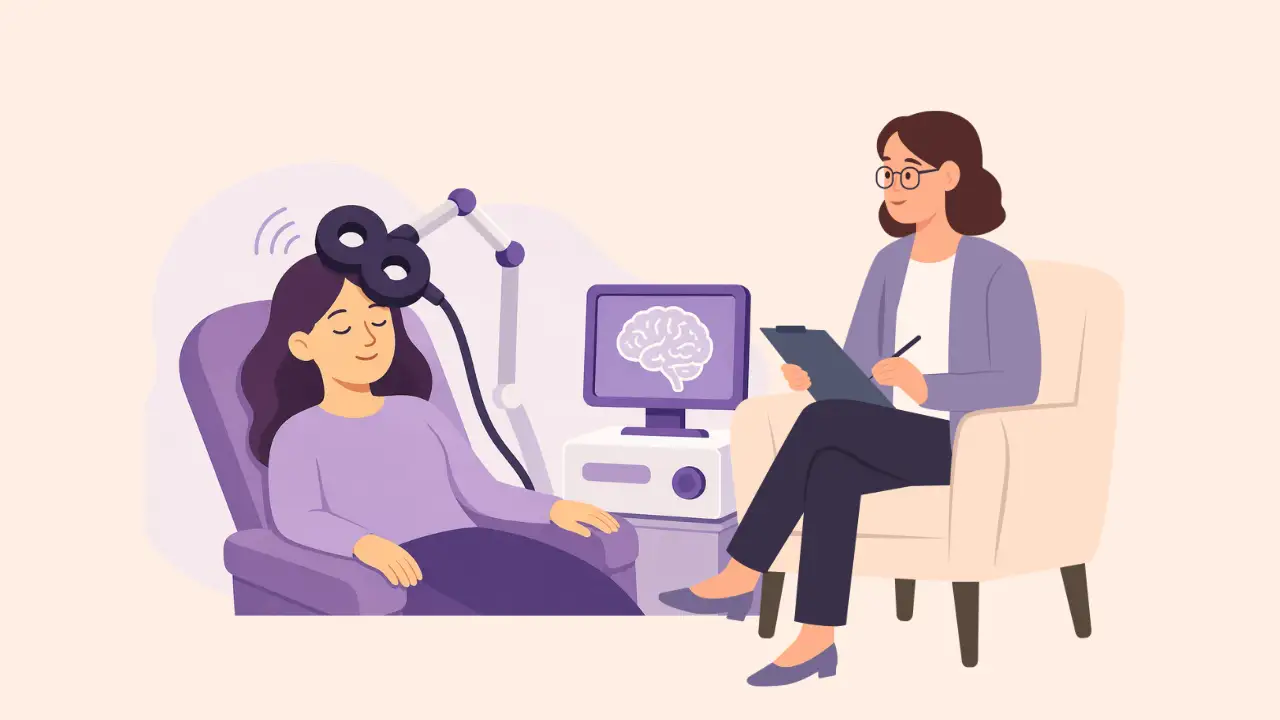
Once your threshold is set, the coil is placed over the target area, usually the left prefrontal cortex for depression, and treatment begins. Most people first notice a tapping feeling on the scalp, like light, fast tapping. Some compare it to a woodpecker, but it feels more odd than painful.

There can be mild scalp discomfort in the first few sessions, especially where the coil touches. This usually improves within a week as your scalp gets used to it. Mild headaches can also happen early on, but they are usually manageable with basic pain relief. These side effects often fade after the first sessions.
During treatment, you stay fully awake and aware. You can talk if you want, listen to music, or use your phone. There is no sedation and no recovery time. Most people drive themselves home and continue their day normally.
The Full Treatment Course
A standard course of TMS services typically involves sessions five days a week for four to six weeks, putting the total somewhere between 20 and 36 sessions depending on your protocol. That time commitment is one of the first things people push back on, and it is a legitimate consideration.
What makes it manageable for most working professionals is that each session runs between 20 and 40 minutes, and because there is no recovery time, you can schedule your workday without much disruption. Some people come before work. Others use a lunch break. The consistency matters more than the convenience, so building it in rather than trying to squeeze it around everything else makes a real difference.
TMS therapy success rate data is worth knowing before you start. Roughly 50 to 60 percent of people with treatment-resistant depression experience a meaningful response, and about one third achieve full remission. Those numbers are significantly better than trying another antidepressant after two or more have already failed, which is exactly where most TMS candidates are when they begin.
What TMS Is Used For
Depression is the primary and most established use, but the clinical applications have expanded considerably as the evidence base has grown.
TMS for PTSD has shown real promise in clinical research. According to the National Center for PTSD, this treatment is particularly relevant for patients whose PTSD has not responded adequately to therapy or medication alone. The mechanism makes sense given that PTSD involves dysregulation in some of the same prefrontal and limbic circuits that TMS targets for depression.
TMS therapy for OCD received FDA clearance through the Brainsway deep TMS therapy system and represents a meaningful option for patients who have not responded to first-line OCD treatments. The protocol targets slightly different brain regions compared to the depression protocol, which is part of why device selection matters in these cases.
Deep TMS therapy is also being explored for anxiety, postpartum depression, and certain presentations of bipolar depression, though the strongest clinical evidence remains in major depressive disorder.
Who TMS Is and Is Not Right For
TMS contraindications are an important part of the evaluation process and something every candidate needs to understand before committing to treatment.
Anyone with metal implants in or near the head, including cochlear implants, aneurysm clips, or certain types of deep brain stimulators, is typically not a candidate. A history of seizures requires careful evaluation before proceeding. As the FDA outlines its full safety and contraindication profile for TMS devices, these restrictions exist for legitimate clinical reasons, not administrative ones.
People who are pregnant, have a history of epilepsy, or take medications that significantly lower seizure threshold need a thorough conversation with their provider before starting. A good TMS clinic near me to search for should lead you to a practice that goes through all of this during the consultation, not after you have already committed.

TMS Therapy Coverage and Cost
TMS therapy insurance coverage has improved considerably over the past several years. Most major commercial insurers now cover TMS for major depressive disorder when specific criteria are met. As the American Psychiatric Association has documented, access to TMS has expanded nationally as payers have recognized the clinical evidence behind it.
TMS therapy covered by insurance still involves a prior authorization process, which your provider’s office should handle on your behalf. What you will likely need to provide is a clear history of which medications you have tried and how they went. The more complete that record is, the smoother the process tends to be.
Transcranial magnetic stimulation of Dallas area providers has grown in number over the past few years, which has made access more realistic for people across North Texas. If insurance does not cover your specific situation, many practices offer financing options worth asking about directly.
Frequently Asked Questions
Honestly, that decision belongs to your provider more than you. Both are FDA-cleared, and both work. The differences come down to the device design, the treatment protocol, and what your clinic actually has available. What matters more than the brand is finding a provider who knows how to use what they have properly.
Look for a psychiatric practice that offers it directly rather than a standalone clinic with no broader mental health support around it. If you are in the Frisco or Dallas area, Beautiful Minds TX at beautifulmindstx.com offers TMS as part of a full psychiatric care model, which means you are not just getting a treatment; you are getting someone who understands your full picture.
Roughly half to two thirds of people who go through a full TMS course see meaningful improvement. About a third experience full remission. Those numbers are actually significant when you consider that most people pursuing TMS have already tried medications that did not work well enough. It is not a guaranteed fix, but it is a legitimate option with real results behind it.
More than most people realize. Depression is the most well-known, but TMS is also used for OCD, anxiety, PTSD, and smoking cessation. Research is still growing in some of these areas, but depression has the strongest evidence behind it by far. If you are wondering whether your specific situation qualifies, that conversation belongs with a psychiatrist who actually offers it.
Getting Evaluated at Beautiful Minds Psychiatry
Beautiful Minds Psychiatry in Frisco offers TMS services as part of a broader psychiatric care model, which means TMS is never offered in isolation. Every patient goes through a proper psychiatric evaluation first, because TMS works best when it is part of a treatment plan, not a standalone procedure someone found online and requested without clinical context.
The practice serves patients across Frisco, Plano, McKinney, Allen, and the wider DFW area. Both telehealth and in-person appointments are available for initial consultations, which makes the first step significantly easier for people with demanding schedules.
If you have been through multiple antidepressants without finding something that works, or if you are looking for a psychiatrist in Frisco, TX, to evaluate whether TMS is appropriate for your situation, Beautiful Minds is equipped to work through that honestly, including telling you if TMS is not the right fit and what else might be worth considering.
Disclaimer: This content is for informational and educational purposes only. It is not a substitute for professional mental health advice, diagnosis, or treatment. If you are in crisis, call or text 988 for the Suicide and Crisis Lifeline.