ADHD in College Students: How to Get Diagnosed and Treated in Texas Before It Derails Your Degree
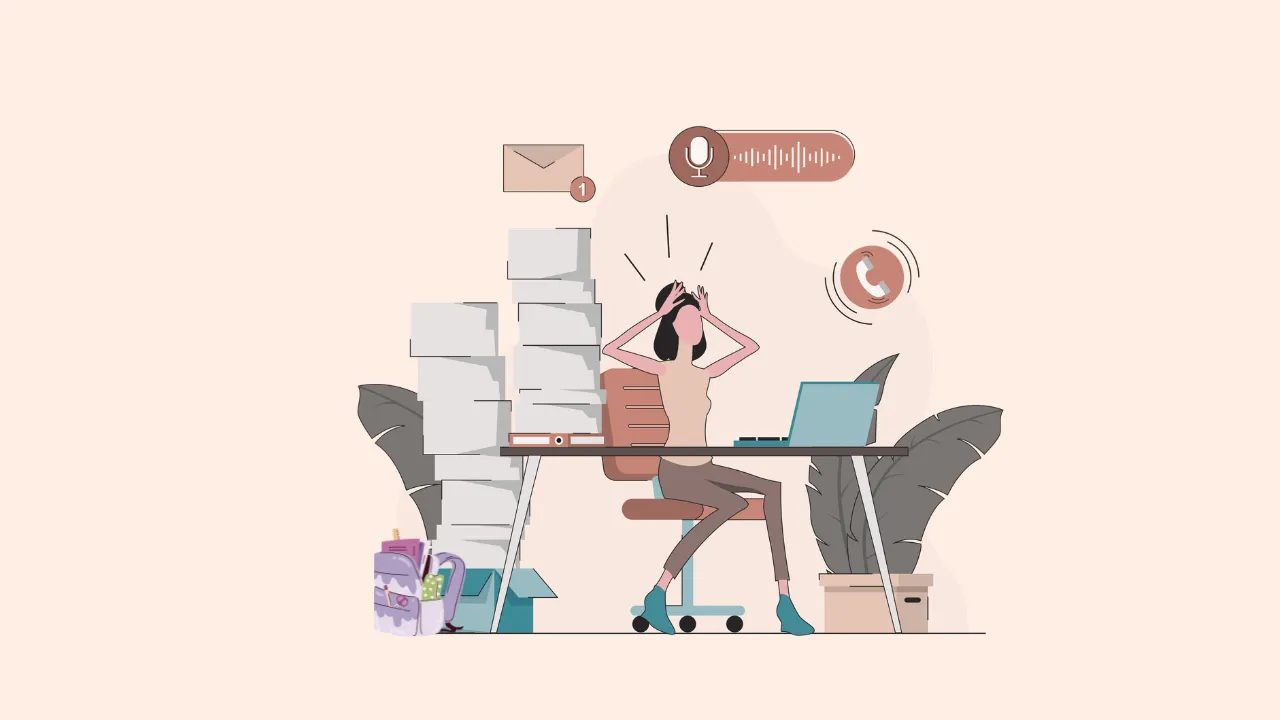
There is a specific kind of exhaustion that hits when you are trying harder than everyone around you and still falling behind. You read the same paragraph four times and nothing lands. You missed a deadline not because you forgot it existed but because your brain just could not get started.
Most college students never connect those struggles to ADHD. They write it off as laziness or just not being smart enough. The truth is ADHD symptoms in college students go unnoticed for years, especially in students who coasted through high school on raw intelligence. College strips away all the structure that was quietly holding things together, and that is exactly when undiagnosed ADHD shows up in full force.
Key Take away:
- Why ADHD symptoms in college students look nothing like what most people expect
- How rejection sensitivity and self-esteem silently take the biggest hit
- What a real ADHD evaluation actually involves and what you do not need to bring
- Why telehealth has made getting diagnosed easier than ever for college students in Texas
- What treatment actually looks like and why medication is only part of the answer
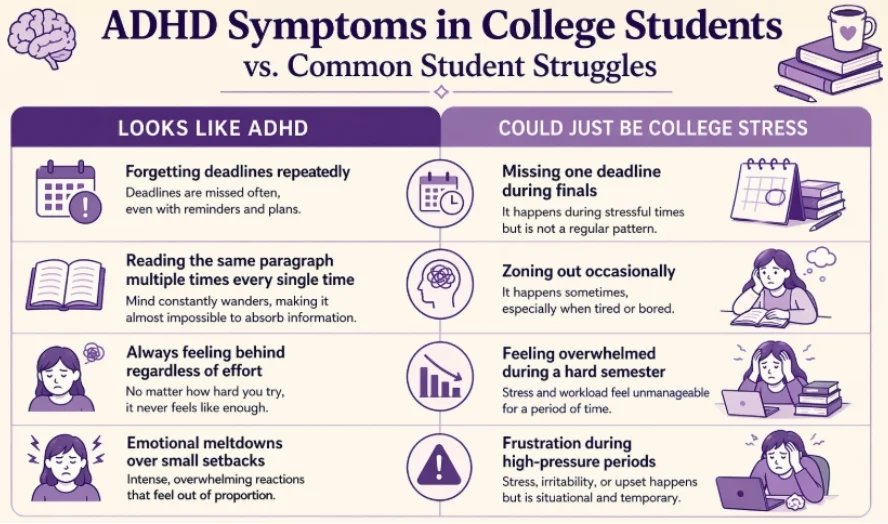
What ADHD Actually Looks Like in College
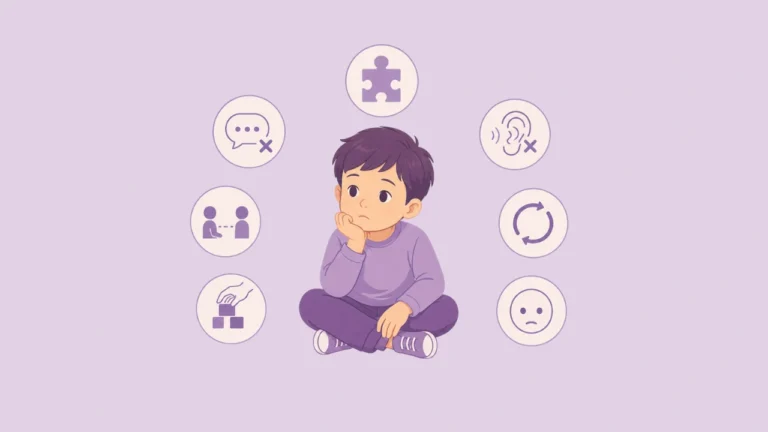
Drop the image of a hyperactive kid who cannot sit still. ADHD in college students look a lot quieter and a lot messier than that.
Combined type ADHD is one of the most common presentations in young adults. It mixes inattentiveness with impulsivity, and that combination can quietly tear apart your academic life before you even clock out what is happening. You start five assignments and finish zero, show up to class but mentally check out ten minutes in, and say things before thinking. Social cues fly right over your head. Choices that look completely reckless from the outside made total sense in your head at the time.
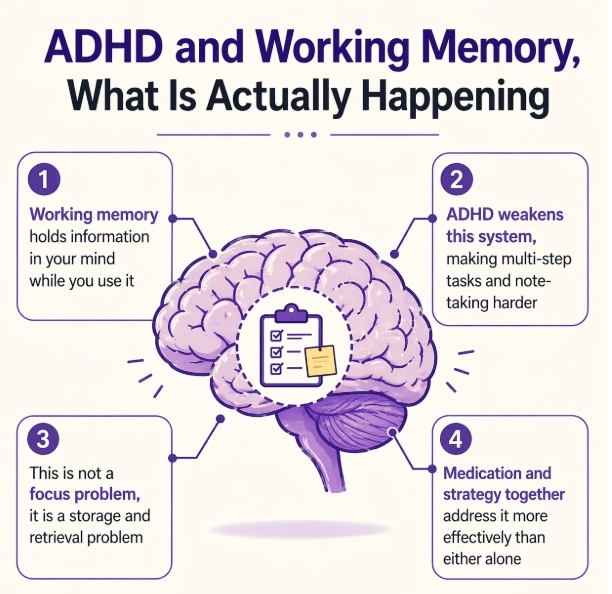
ADHD and working memory problems explain a lot of why college feels impossible. Working memory is what lets you hold information in your head while actively using it, like keeping your professor’s instructions in mind while you take notes or holding step one in your head while you work through step three. When that system keeps failing you, studying turns into a fight you never feel close to winning.
ADHD and self-esteem take a hit that builds slowly over time. Years of struggling without knowing why leave a mark. Many students with undiagnosed ADHD walk into college already carrying real shame. They have spent their whole lives hearing that they are smart but lazy, full of potential but somehow not delivering on it. That story becomes part of how they see themselves, and a diagnosis alone does not erase it overnight.
Why ADHD and Studying Feel Like Oil and Water
Studying demands the kind of sustained, voluntary focus that ADHD makes genuinely hard to pull off. Your brain is not broken. It can absolutely lock in on things that feel interesting or urgent. The problem is that routine studying almost never trips either of those wires.
ADHD and studying struggles tend to play out the same way repeatedly. You sit down to work, open your laptop, and twenty minutes later you are deep into something completely unrelated. Two hours go by and almost nothing gets absorbed because your mind kept slipping away. The night before a deadline is sometimes the only time real work happens, because that is when the pressure finally gives your brain enough urgency to kick in.
ADHD productivity tools have their place, but they work best when real treatment is already part of the picture. Apps like Focus mate, time-blocking methods, and body doubling are worth using, but they are support strategies, not solutions. Plenty of students spend years trying to productivity-hack their way through unmanaged ADHD. It works just enough to keep them from ever getting real help.
The Part of ADHD and Rejection Sensitivity Nobody Talks About
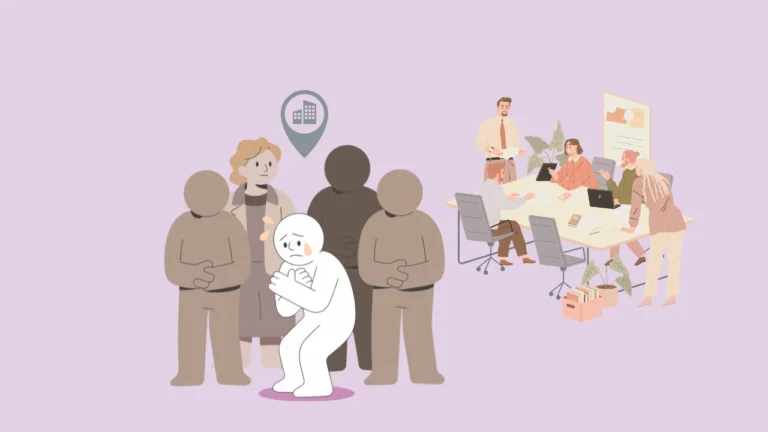
One of the least talked about but most painful parts of living with ADHD is rejection sensitive dysphoria. ADHD and rejection sensitivity tend to travel together, and for a lot of college students, this is the symptom of doing the quietest damage.
Rejection sensitive dysphoria is when criticism, failure, or feeling left out hits you way harder than it should, even when the situation itself is not that serious.Notice the word perceived. Your professor leaves a brief comment on your paper and your whole day falls apart. A friend takes too long to reply, and your brain has already decided they are done with you. Someone offers feedback with good intentions, and it lands like a direct attack.
This is not being dramatic or thin-skinned. Your brain processes emotional pain harder and faster than it should, and ADHD drives that entire pattern. It touches friendships, group projects, professor relationships, and ADHD and romantic relationships in ways that feel genuinely overwhelming. Many students with ADHD describe their closest relationships as a constant low-grade source of anxiety because the fear of rejection never fully quiets down.
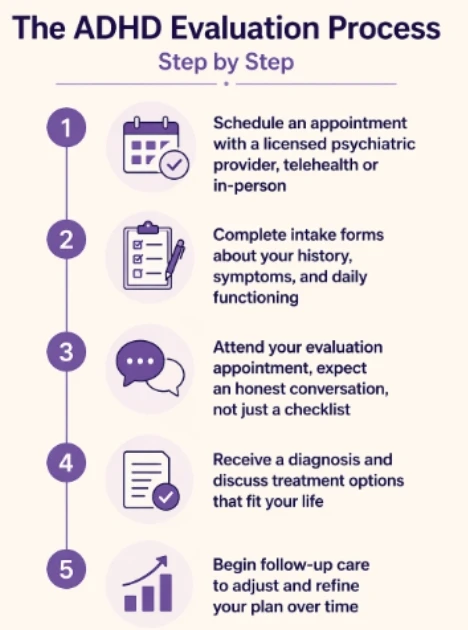
What the Diagnosis Process Actually Looks Like
Getting an ADHD evaluation in college is a lot more straightforward than most people expect. No referral from a childhood doctor. No digging up old report cards or teacher notes. What you actually need is an appointment with someone qualified to evaluate adults.
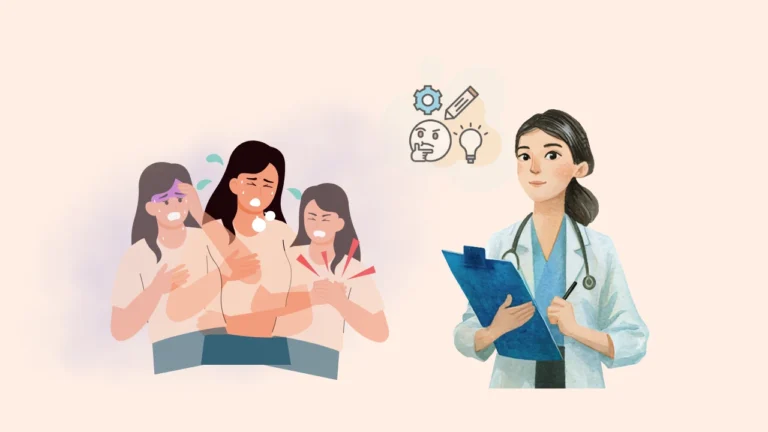
A real ADHD evaluation looks at your history, your current symptoms, how those symptoms show across different parts of your life, and whether something else might better explain what is going on. Anxiety, depression, sleep problems, and learning differences can all look like ADHD or sit right alongside it. A thorough evaluation works through all of that instead of handing out a diagnosis based on a ten-minute questionnaire.
Telehealth ADHD diagnosis has made getting help much more realistic for college students. No full day off. No driving across town. An online ADHD evaluation can happen from your dorm room, your apartment, or anywhere you have thirty minutes between classes. Texas has solid options for licensed psychiatric providers who do virtual evaluations and genuinely understand what ADHD looks like in college-aged adults.
One thing worth holding onto: a diagnosis you get as an adult is just as real as one from childhood. Late diagnosis happens all the time, particularly in women, high achievers, and people who built strong coping habits early on. Getting diagnosed at 19 or 22 or 25 is not late. It is just when the right information finally reached you.
What Works in Treatment and What You Should Expect
For most people, medication genuinely changes things. Vyvanse for ADHD is one of the more commonly prescribed options for college students, and for good reason. It is a long-acting stimulant that delivers a smoother, more consistent effect across the day compared to shorter-acting options. That matters a lot when back-to-back classes, long study sessions, and everything else college throws at you all demand the same level of focus.
Medication on its own does not do the whole job, and it was never meant to. ADHD and therapy work well together because therapy gets at the patterns, habits, and emotional weight that medication cannot touch. Cognitive behavioral therapy specifically targets task initiation, planning, and the kind of deeply ingrained negative self-talk that builds after years of struggling without ever understanding why.
ADHD and entrepreneurship share more common ground than most people realize. The same brain that fights routine tasks and rigid structure often does remarkably well when given real autonomy, novelty, and work that actually means something. Plenty of successful founders and creatives have ADHD, and treatment is not about flattening those qualities. Getting the right support means reducing the friction, so you can reach your strengths consistently, not just when every condition happens to line up.
No good treatment plan looks the same for two different people. It gets shaped by how you respond, what your schedule actually looks like, and what you are trying to accomplish right now. Regular follow-ups with your provider are not optional. That ongoing relationship is the part that makes treatment actually work long term.
Frequently Asked Questions
Stop trying to hold things in your head, that is the main thing. Write it down the second it lands. Study in short bursts with real breaks, not marathon sessions that drain you. Teaching the material out loud to yourself, even if it feels strange, makes it stick way better than reading the same paragraph over and over.
Cognitive behavioral therapy tends to work well for both. It is practical and focuses on real patterns like organization, follow-through, and the negative self-talk that quietly builds up after years of struggling. Some people add ADHD coaching alongside it specifically for daily functioning, and that combination tends to work really well.
Routine, structure, and cutting down daily decisions genuinely help. Exercise is probably the most slept-on tool out there because it actually improves focus and mood in a real way. That said, if things are hard enough that you are actively searching for answers, that is already a sign that talking to someone is worth considering.
ADHD directly weakens working memory, meaning your brain struggles to hold and use information in the moment. That is exactly why multistep tasks and long instructions feel so much harder than they should.
Completely. ADHD type and personality have nothing to do with each other. Combined type ADHD can actually make social situations feel more draining, not less.
Getting Support at Beautiful Minds Psychiatry
If you are a college student in the Frisco or greater Dallas area and you have been quietly wondering whether ADHD might be part of what you are dealing with, Beautiful Minds Psychiatry offers comprehensive psychiatric evaluations for adults and college-aged patients.
The practice offers both telehealth and in-person appointments, so getting evaluated does not mean turning your whole week upside down. The team knows that ADHD in young adults rarely looks like it does in textbooks, and evaluations go deep enough to catch what quick screenings consistently miss.
Questioning a diagnosis for the first time, establishing care after being diagnosed somewhere else, or revisiting a treatment plan that stopped working, Beautiful Minds meets you exactly where you are and helps you figure out what comes next without ever making you feel like just another case to get through.
Disclaimer: This content is for informational and educational purposes only. It is not a substitute for professional mental health advice, diagnosis, or treatment. If you are in crisis, call or text 988 for the Suicide and Crisis Lifeline.