Mental Health Treatment for Teens When Anxiety and Social Media Win
Most parents do not get a clear moment where they realize something is wrong with their teenagers. It happens gradually. The kid who used to talk all the way home from school goes quiet. The one who loved a sport or a hobby stops showing up to practice. Grades slip a little, then a lot. Sleeping becomes irregular. The door stays closed more than it used to.
By the time most DFW parents start looking into mental health treatment for teens, they have already spent weeks or months wondering if they are overreacting. This blog is for parents who are done wondering and ready to understand what they are actually looking at.
Key takeaway:
- What signs of depression in teenagers look like beyond the obvious
- How teen social anxiety develops and why it often gets missed
- What teen eating disorder treatment involves and when to pursue it
- How social media connects to what your teenager is going through
- What teen anxiety treatment looks like in practice
- Where Frisco and DFW parents can find real support including online teen counseling and in-person care
What Teen Mental Health Actually Looks Like Right Now
Teen mental health treatment has become one of the most searched topics among DFW parents in recent years, and the numbers behind that search make sense. According to the CDC, rates of persistent sadness and hopelessness among high school students have climbed steadily over the past decade, with significant spikes following the pandemic years.
What most parents are not prepared for is how different teen mental health struggles look from adult mental health struggles. Teenagers do not always present with obvious sadness. More often what parents see is irritability, anger, withdrawal, or a kind of flatness that is easy to write off as typical teenager behavior. The challenge is knowing when typical ends and something more serious begins.
Teen mental health treatment works best when it starts early, before patterns become entrenched, and before a teenager has spent years developing coping mechanisms that create their own problems. Getting an evaluation when something feels off is not an overreaction. Waiting until things are clearly falling apart is where most families lose significant ground.
Signs of Depression in Teenagers That Parents Miss
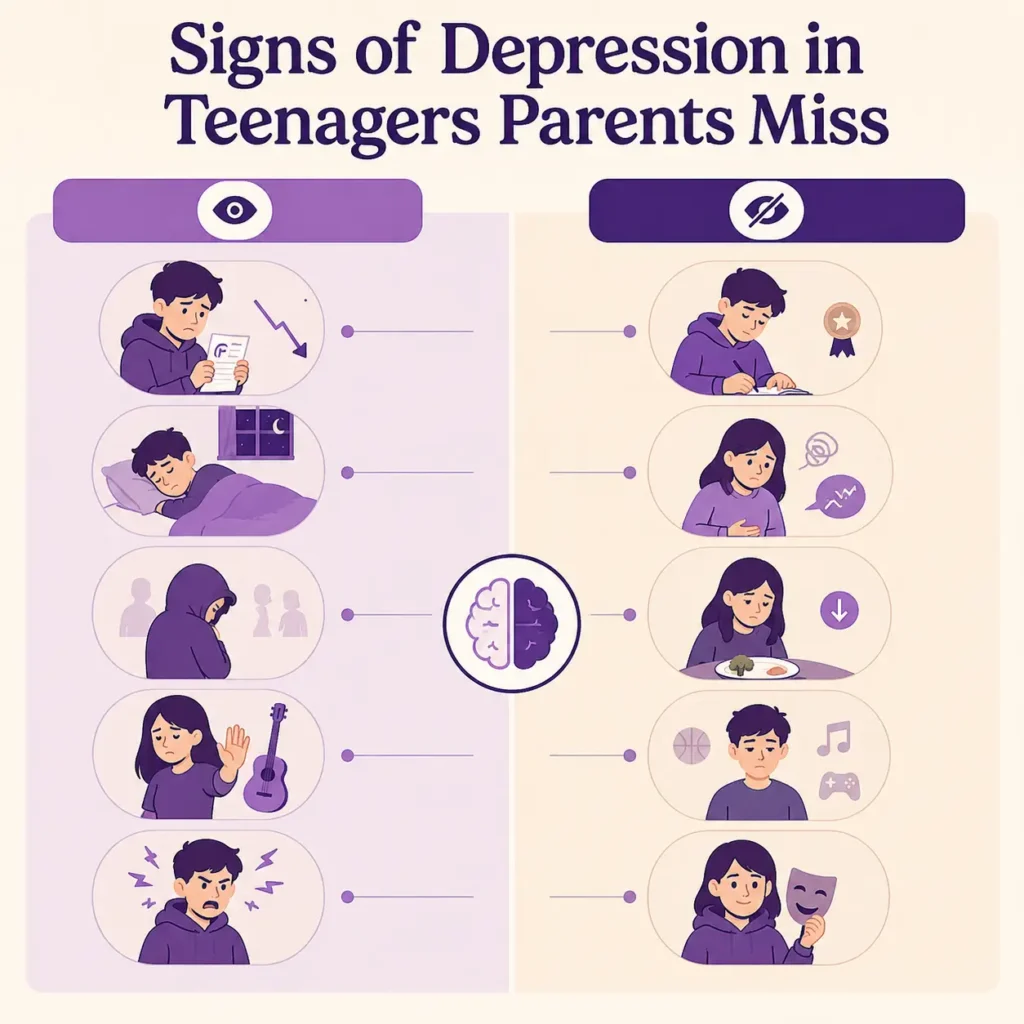
Signs of depression in teenagers rarely look like sadness. More often they look like a kid who is constantly tired, has stopped caring about things they used to love, snaps at everyone in the house, and has quietly pulled away from friends without explanation.
Signs of depression in teenagers also show up in the body. Stomachaches before school, recurring headaches, and a pattern of feeling sick that lines up with situations they want to avoid are all worth taking seriously.
Eating changes matters too. Skipping meals regularly, significant weight shifts, or eating in response to emotions rather than hunger can all signal something beneath the surface worth addressing.
The sign parents miss most is the teenager who seems fine. Good grades, showing up, performing well where it counts. Signs of depression in teenagers who are high achieving can be completely invisible from the outside while internally they are exhausted, empty, and going through the motions of a life that does not feel real.
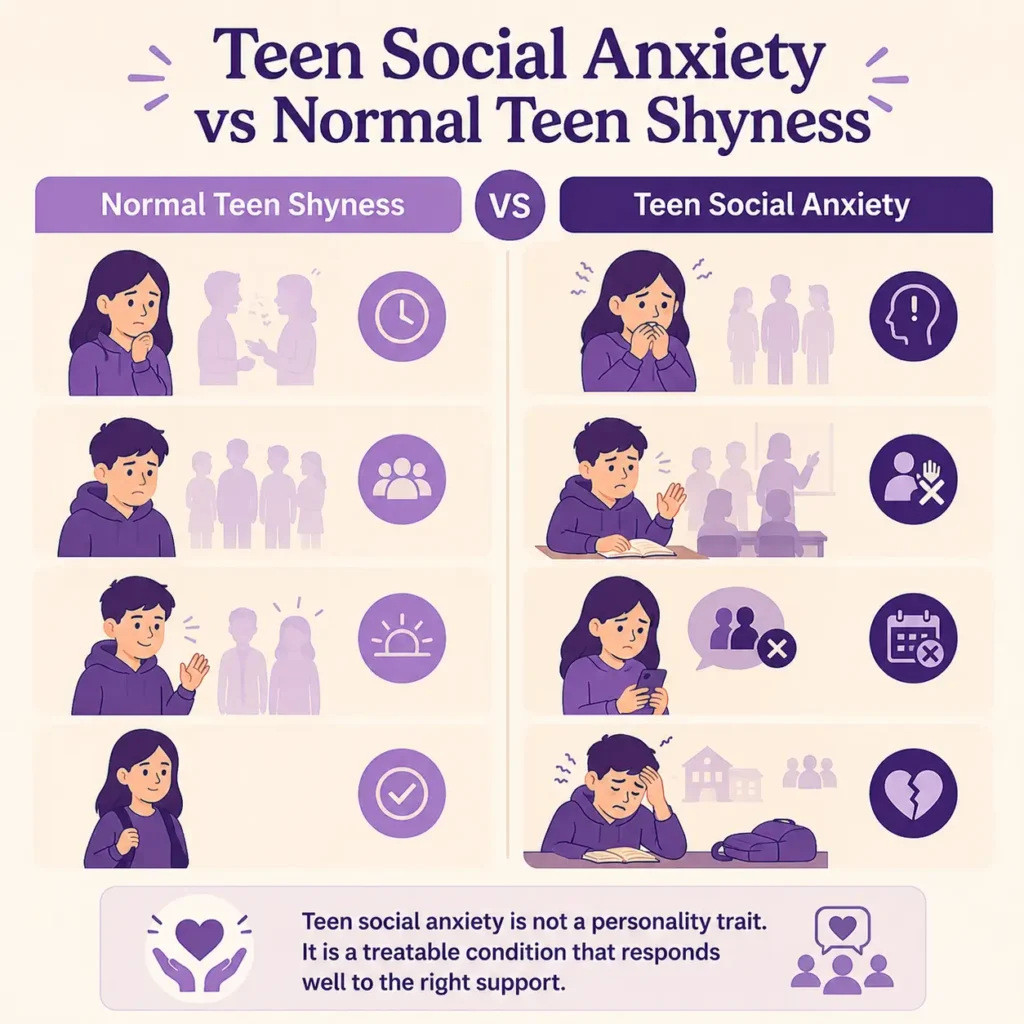
Teen Social Anxiety: What It Looks Like Beyond Shyness
It is one of the most common and most undertreated conditions in adolescence, partly because it is so easy to confuse with introversion or simply being a quiet kid.
Teen social anxiety goes beyond not loving parties or preferring smaller groups. It involves a persistent fear of being judged or humiliated in social situations. A teenager with social anxiety might avoid speaking in class even when they know the answer, skip lunch to avoid the cafeteria, or decline invitations consistently not because they don’t want connection, but because the fear of rejection feels unbearable.
Teen social anxiety shows up heavily online too. The same teenager who seems confident on social media can be completely paralyzed face-to-face. Digital spaces give anxious teenagers more control over self-presentation, which quietly reinforces avoidance of real-world situations where that control doesn’t exist.
Left untreated, teen social anxiety narrows a teenager’s world gradually. The avoidance that feels protective short-term builds a smaller life, and by the time they reach adulthood, the patterns are deeply embedded and significantly harder to shift.
Social Media and Teen Mental Health
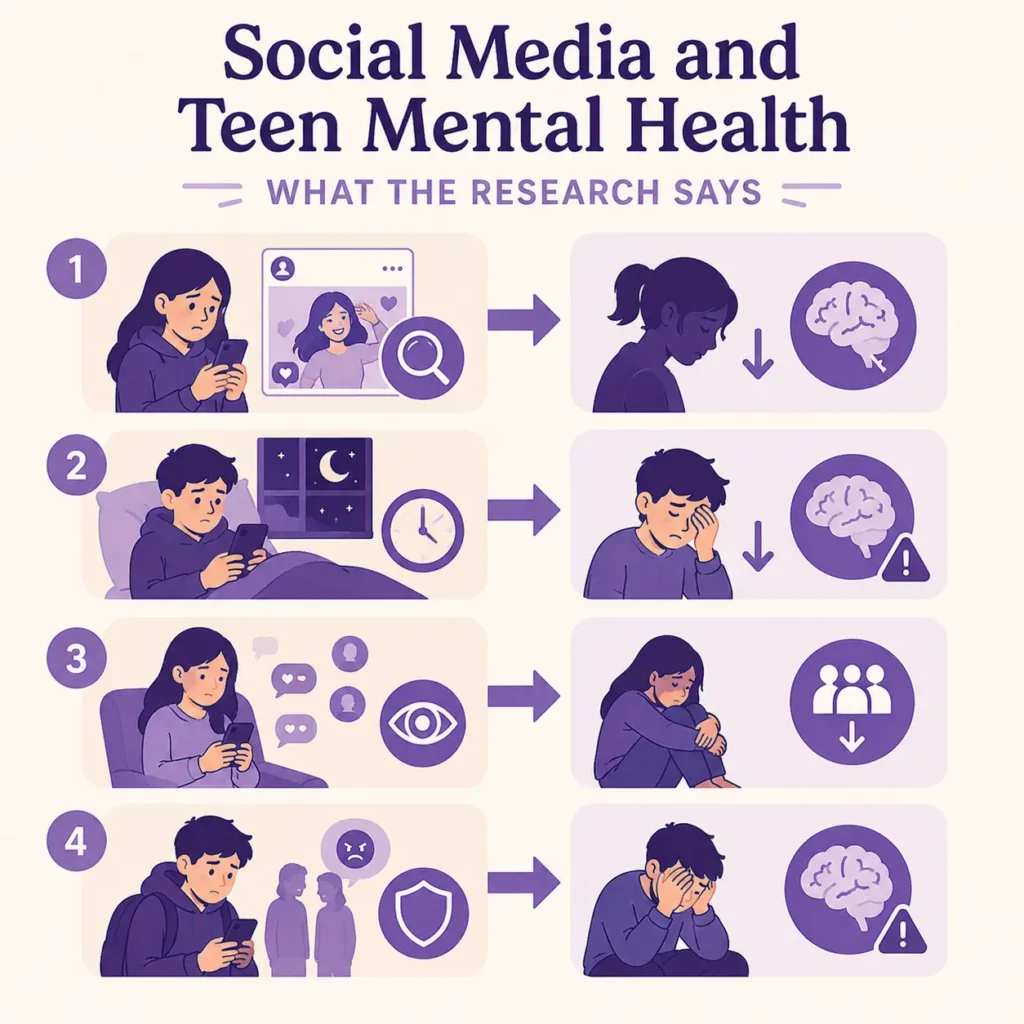
The connection between social media and teen mental health is real, and it is worth understanding clearly rather than either dismissing it or catastrophizing it.
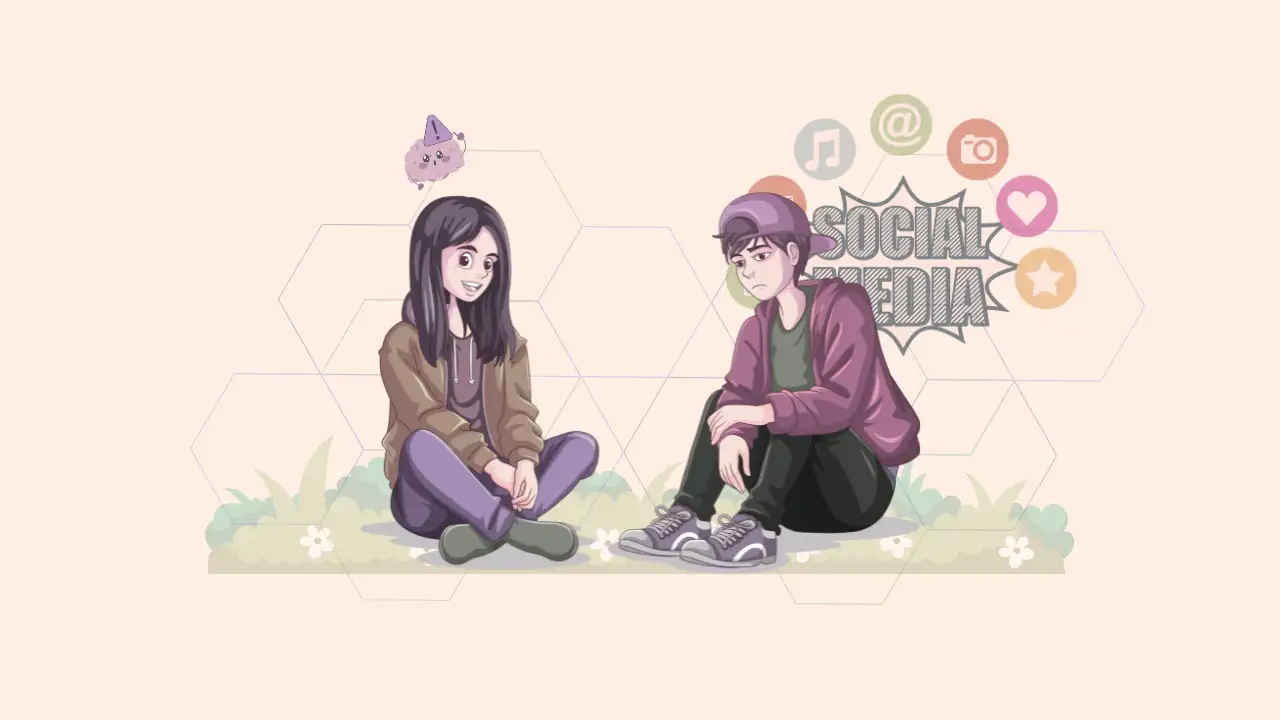
Social media does not cause depression or anxiety in teenagers who are otherwise well. What it does is amplify and accelerate experiences that already exist. Constant social comparison on social media hits hardest for teenagers who are already struggling with self-esteem. For teenagers dealing with teen social anxiety, the gap between how they present online and how they feel offline grows wider with every scroll. And for teenagers who are already lonely, passive scrolling creates an illusion of connection that actually deepens the isolation rather than relieving it.
Sleep is one of the most direct mechanisms. Research from the American Academy of Pediatrics shows teenagers who use screens before bed consistently experience disrupted sleep and disrupted sleep is one of the strongest predictors of both depression and anxiety in adolescents. The phone in the bedroom is not a small thing. It is worth addressing directly in any conversation about teen mental health.
The goal isn’t eliminating social media that’s impractical and likely to damage the relationship you need to keep open. The goal is honest conversation about what your teenager is actually experiencing in those spaces and whether it’s making them feel better or worse about themselves.
What Actually Works for Teen Anxiety Treatment
Teen anxiety treatment has a strong evidence base, and outcomes are genuinely good when the right approach is in place early enough.
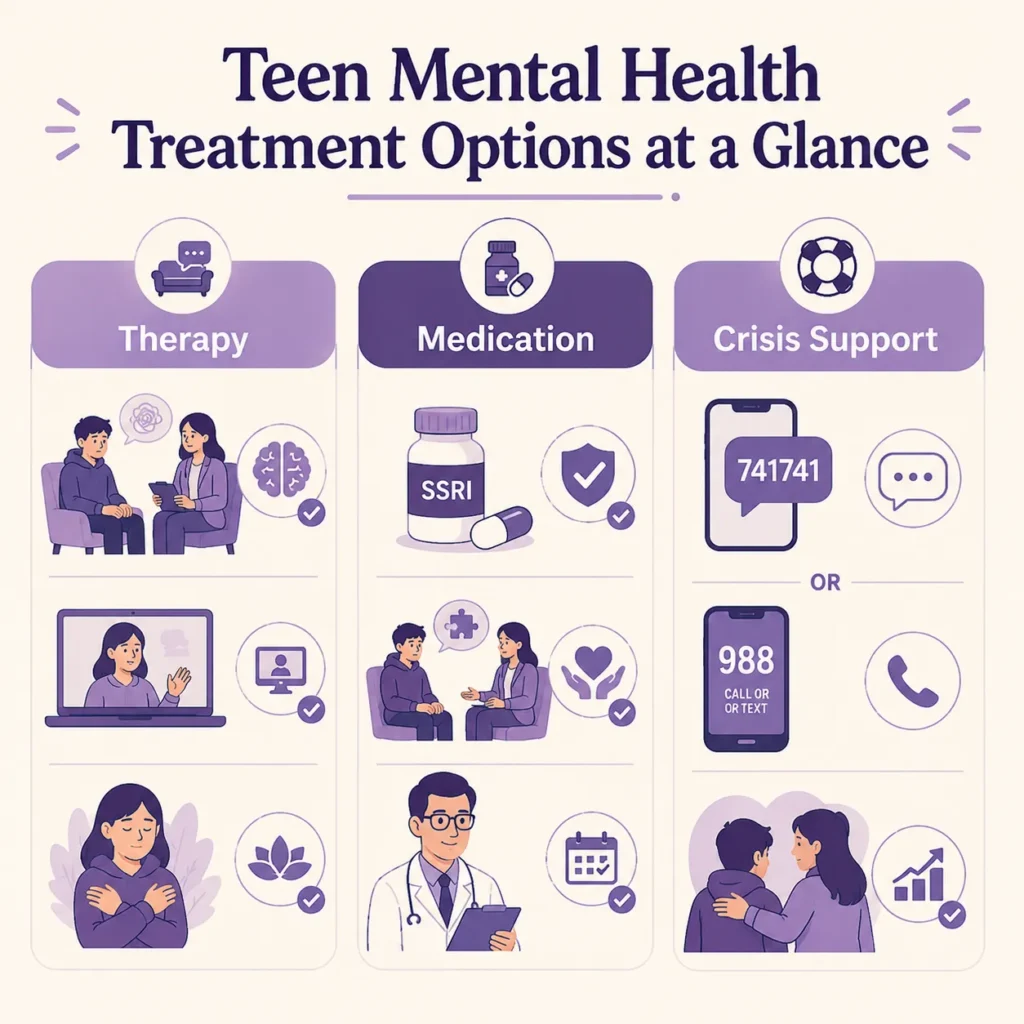
Cognitive behavioral therapy is the most well-supported treatment for teen anxiety, including teen social anxiety. It works by identifying the thought patterns that feed the fear, testing whether those thoughts hold up, and building real experience of situations that turned out fine. Exposure work is part of it, but it is gradual and guided, not a push into overwhelming situations.
Medication is part of the picture for some teenagers, particularly when anxiety is severe enough that therapy alone cannot gain traction. SSRIs have strong evidence of anxiety disorders in adolescents and are often used alongside therapy rather than instead of it. The decision about medication belongs between the family, the teenager, and a psychiatrist who knows the full picture.
Teen eating disorder treatment is a more specialized area that requires a provider with specific experience in this population. Eating disorders in teenagers carry the highest mortality rate of any mental health condition, which is why early intervention matters so much. Teen eating disorder treatment typically involves a team approach psychiatric care, nutritional support, and therapy with family involvement playing a significant role, particularly for younger adolescents.
Finding Help: Online Teen Counseling and In-Person Options
One of the most common barriers to mental health treatment for teens is logistics. School, extracurriculars, and packed family schedules make fitting in appointments genuinely difficult, and driving across town weekly adds friction that keeps families from following through.
Online teen counseling has changed that significantly. A teenager can connect with a licensed therapist from their own room, on a schedule that fits around school. Research consistently shows online teen counseling produces outcomes comparable to in-person therapy for anxiety and depression and for teenagers already comfortable communicating through screens, the virtual format often feels more accessible than sitting across from a stranger in an office.
For parents searching for a psychologist for teens near me in the DFW area, the most important factor is finding someone with specific adolescent experience rather than a general adult practice that also sees teenagers. The approach, language, and therapeutic relationship needs to fit a teenager’s developmental stage, not just apply adult frameworks to a younger person.
For crisis moments, a teen mental health hotline is worth having ready. Crisis Text Line text HOME to 741741 is available around the clock. The 988 Suicide and Crisis Lifeline is also available by call or text for any teenager in acute distress.
Frequently Asked Questions
Look at patterns and duration. A persistent shift in functioning lasting more than a month of lost interests, withdrawal, or significant irritability warrants a proper teen mental health treatment evaluation rather than waiting it out.
Start with the relationship. A teenager who feels heard at home is more likely to agree to outside support. Online teen counseling or a free online therapist for teenagers can be an easier entry point than a traditional office setting.
Teen anxiety treatment covers generalized worry and panic broadly. Teen social anxiety treatment focuses specifically on fear of social judgment. A good psychologist for teens near me will identify which presentation is most prominent and tailor mental health treatment for teens accordingly.
A teen mental health hotline is right for acute distress or suicidal thoughts. For ongoing signs of depression in teenagers, teen eating disorder treatment, or teen anxiety treatment, a proper evaluation and regular teen mental health treatment plan is more effective long term.
Getting Support at Beautiful Minds
Beautiful Minds Frisco offers mental health treatment for teens across DFW, including evaluation and treatment for teen anxiety, teen social anxiety, and depression.
The practice understands teenagers are not small adults. Evaluations consider developmental context, family dynamics, school environment, and what the teenager is experiencing. Both telehealth and in-person appointments are available, making it easier for busy families to get started.
If something feels off with your teenager, that feeling is worth acting on. Teen mental health treatment works and the earlier it starts, the better the outcomes tend to be. Reach out to Beautiful Minds Frisco today.
Disclaimer: This content is for informational and educational purposes only. It is not a substitute for professional mental health advice, diagnosis, or treatment. If you are in crisis, call or text 988 for the Suicide and Crisis Lifeline.