What Happens During a Psychiatric Evaluation?

Most people put it off for the same reason. Not because they do not think something is wrong. But because they have no idea what happens once, they walk through the door.
What happens during a psychiatric evaluation is one of the most searched questions people type in before their first appointment. And honestly, that makes complete sense. You are about to sit across from a doctor and talk about some of the most personal parts of your life. Knowing what to expect makes the whole thing feel a lot less like a leap into the dark.
It Starts Long Before You Sit Down
By the time you schedule a psychiatrist, you have probably already been carrying whatever you are dealing with for a while. Maybe months. Maybe years. The evaluation is not the hard part. The hard part was deciding to come in.
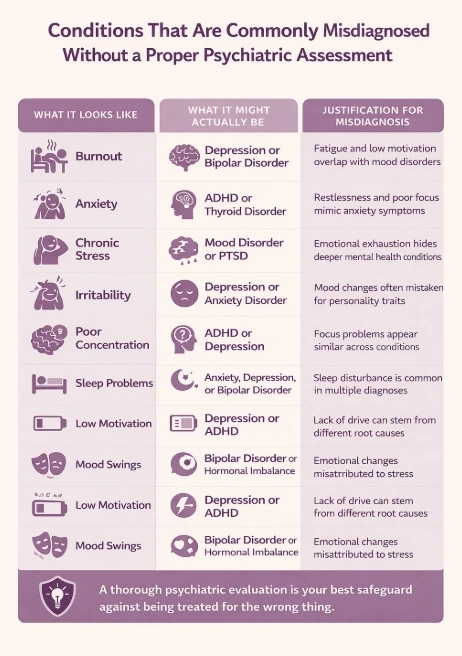
When you arrive, the first thing that happens is to intake paperwork. You will fill out forms about your current symptoms, your medical history, any medications you are on, and sometimes a short behavioral health screening questionnaire. These are not trick questions. They are just a way for your provider to walk in already having a basic picture of where you are starting from.
Think of it less like a test and more like the first page of a conversation.
What a Psychiatric Assessment Actually Covers
A lot of people imagine a psychiatric assessment as something clinical and cold. A checklist. A set of boxes that get ticked. A good evaluation feels more like someone finally asking you the questions nobody else has thought to ask.
Your psychiatrist will want to know about your current symptoms, yes. But they will also ask about your sleep, your appetite, your relationships, how you are functioning at work or school, and whether anyone in your family has dealt with similar struggles. That last part matters more than people realize. Mental health conditions often run in families and knowing that history helps your provider understand what they might be looking at.
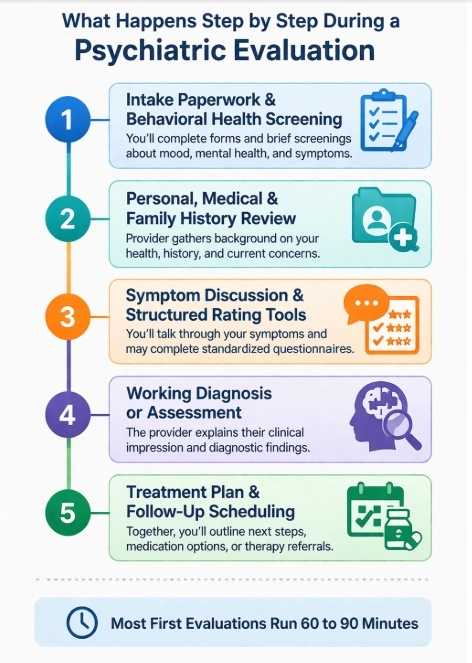
This is also where your doctor catches any misdiagnosis risks head on. A thorough first evaluation seriously protects you from getting treated for the wrong thing. Anxiety can look a lot like ADHD. Depression can easily pass for burnout. Bipolar disorder often gets confused with chronic stress. Taking the time to do a careful, unhurried psychiatric assessment makes sure your doctor doesn’t miss those differences.
What Is a Psychiatric Evaluation Really Testing For
People sometimes walk in thinking about what a psychiatric evaluation is going to reveal about me, almost like it is going to produce some kind of verdict. It is not that.
What is a psychiatric evaluation really doing is giving your provider a complete picture of how you are functioning mentally, emotionally, and sometimes physically, so they can put together a plan that makes sense for your specific situation. It is not about labeling you. It is about understanding you well enough to help.
Your psychiatrist might also use a few set tools at this stage, like simple rating forms for depression, anxiety, or ADHD, to better understand how strong your symptoms feel. These are not tests you can pass or fail. They just give more detail about what you’re going through.
What to Expect at a Psychiatric Evaluation in Terms of Time
Here is the practical question most people have before they go in. What to expect at a psychiatric evaluation in terms of how long it takes and what the flow looks like.
A first appointment typically runs between 60 and 90 minutes. That is longer than a regular doctor’s visit, and it is longer on purpose. You cannot really understand someone’s mental health in 15 minutes. The extra time is what makes the difference between a surface-level check and a real mental health checkup.
Your doctor will probably ask you to talk about things you’ve never said out loud before. That can feel uncomfortable, or honestly, it can feel like a huge relief. Sometimes both feelings hit at the same time. Either way, a good practice will never rush you through any of it.
The Misdiagnosis Problem and Why the Evaluation Is the Fix
This part is worth slowing down on because it is something a lot of people do not think about until it has already happened to them.
Misdiagnosis of mental health situations is more common than most people realize. One person might spend years treating depression, then later learn they actually have bipolar disorder. Someone else may think they’re dealing with anxiety, but a thyroid problem or a sleep issue is really causing it. Some people deal with ADHD symptoms for years, yet no one ever takes the time to properly check and understand what’s really going on.
A comprehensive psychiatric evaluation, done carefully and without shortcuts, is the single best protection against that. According to the National Alliance on Mental Illness, the average person waits 11 years between the onset of symptoms and getting proper treatment. A lot of that happens because people don’t get checked properly from the start.
At Beautiful Minds Psychiatry, the evaluation process is built to be thorough specifically because getting the diagnosis right at the beginning changes everything that comes after.
What Happens After the Evaluation
Once your psychiatrist has a clear picture of what you are dealing with, the two of you will talk through what comes next. That might mean medication, therapy, a combination of both, or in some cases more specialized treatment.
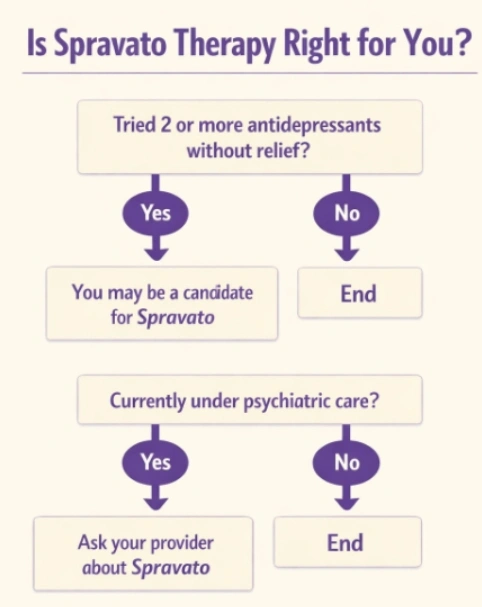
For patients dealing with depression that has not responded to standard treatments, Beautiful Minds offers Spravato therapy as part of their care options. If you have been searching for Spravato treatment near me in the Frisco or greater DFW area, this is one of the few practices in North Texas where that treatment is available alongside ongoing psychiatric care. Doctors specifically use Spravato therapy for adults whose depression simply won’t budge, no matter how many regular medications they’ve already tried. Getting it from a practice that already knows your full history makes your whole care experience feel way more connected and on point.
Before you wrap up, your doctor will walk you through what your follow-up schedule looks like. Early on, you’ll likely come in more often. Once things start to settle down, those visits spread out naturally. Your doctor builds that timeline around how you’re actually doing, not some cookie-cutter schedule they hand to everybody.
You Get to Ask Questions Too
One thing people often forget is that an evaluation is not one-directional. You are not just being assessed. You are also figuring out whether this is the right provider and the right practice for you.
Come with questions. Talk to your psychiatrist about what they think is really going on. Have them walk you through the plan and explain why they chose it. Find out how long it might take before you start to feel a change. Let them know you want to understand what to do if things feel worse before they get better.
A good psychiatrist welcomes that. It is a sign that you are engaged in your own care, and engaged patients almost always do better.
FAQ
A psychiatric evaluation is basically a deep, honest conversation with a licensed psychiatrist. It covers your symptoms, personal history, daily habits, and how you’re functioning overall. If you’ve been struggling emotionally or mentally for a while and still don’t have clear answers, this evaluation is exactly what you need.
A behavioral health screening is just a short set of questions doctors use to catch red flags early. It helps figure out if you need a closer look. A full psychiatric evaluation goes way deeper, covering your diagnosis, history, and a real treatment plan built around you.
Spravato is an FDA-approved nasal spray for adults whose depression hasn’t responded to regular antidepressants. If multiple medications haven’t helped, this could be worth trying. Beautiful Minds Psychiatry offers Spravato treatment near Frisco TX as part of their advanced care options.
100% yes. Misdiagnosis happens more than people realize. Conditions like bipolar disorder, ADHD, and anxiety often get mixed up. A thorough evaluation at Beautiful Minds gives you real clarity on what’s actually going on.
Nothing complicated is needed. Show up ready to talk honestly about what you’ve been feeling and for how long. Bring a list of your current medications and any past mental health records if you have them. Honesty is truly the only thing that matters here.
Finding a Psychiatric Evaluation in Frisco TX
If you have been sitting on this decision and searching for a mental health, checkup or a Frisco TX psychiatrist who has availability for new patients, Beautiful Minds Psychiatry at 8501 Wade Blvd Suite 110, Frisco TX 75034 is currently welcoming new patients across all age groups.
The practice offers both in-person and telehealth appointments, serves children, adolescents, adults, and older adults, and provides a full range of psychiatric services from initial evaluation through long-term care. You can also read more about what to expect from your first appointment on their website before you call.
Reach out at (972) 668-3109 or click the below button. The first step is just making the call.
Disclaimer: This content is for informational and educational purposes only. It is not a substitute for professional mental health advice, diagnosis, or treatment. If you are in crisis, call or text 988 for the Suicide and Crisis Lifeline.