Psychiatric Medication Management: What Patients Should Know in Texas
There is a moment a lot of people describe where they finally get a diagnosis, feel relieved for about five minutes, and then realize they have absolutely no idea what comes next.
They got a prescription. Maybe they will fill it out. Maybe they sit on it for a week trying to decide if they actually want to take it. And then the questions start piling up. Is this the right medication? How long before did it do anything? What happens if it makes things worse? Who do they even call?
That gap between getting a diagnosis and actually feeling supported through psychiatric medication management is where a lot of people fall through the cracks. This is an attempt to close that gap a little.
Does a Psychiatrist Prescribe Medication?
This is one of the most searched questions before a first appointment, and it is worth answering directly.
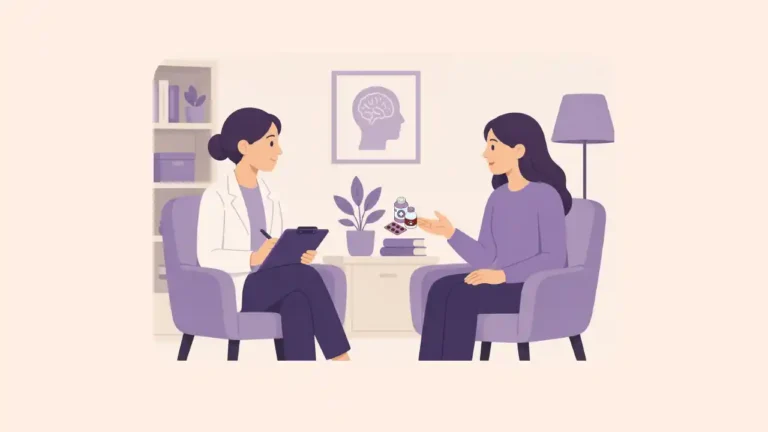
Yes. Does a psychiatrist prescribe medication? absolutely. A psychiatrist is a fully licensed medical doctor who completed medical school, a residency in psychiatry, and in many cases additional specialized training. Prescribing and managing psychiatric medications is a core part of what they do.
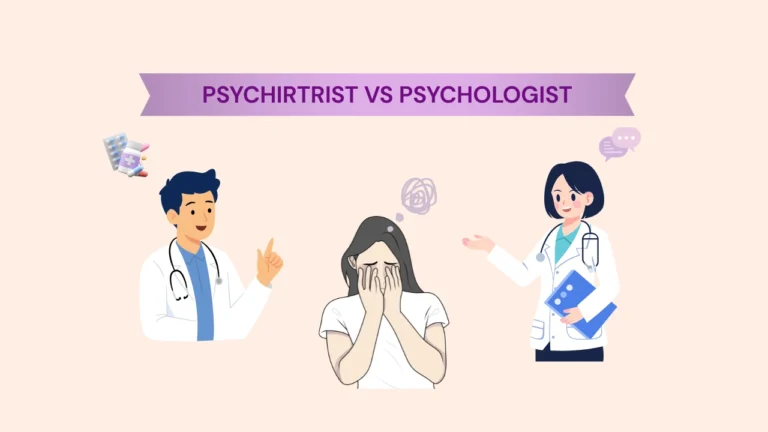
This is one of the key differences between a psychiatrist and a therapist. A therapist, whether a licensed counselor, a social worker, or a psychologist, provides talk-based care. They cannot write prescriptions. A psychiatrist can do both: prescribe medication and in many cases provide therapy alongside it.
That distinction matters a lot when you are trying to figure out who to call first.
Who Can Prescribe Psychiatric Medication?
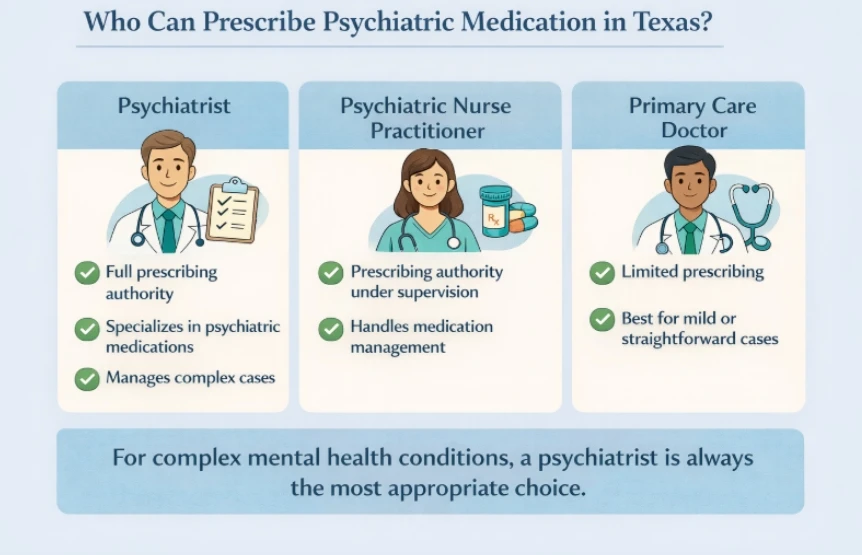
Beyond psychiatrists, who can prescribe psychiatric medication in Texas includes a small group of licensed providers.
Your primary care physician can technically prescribe some psychiatric medications, particularly antidepressants for mild to moderate depression or anxiety. But primary care doctors are generalists. They don’t specialize in how psychiatric medications interact with each other. Managing complex cases takes a different level of training. Recognizing when a diagnosis needs a full rethink is something that comes with years of focused psychiatric experience.
Psychiatric nurse practitioners can also prescribe psychiatric medication in Texas. At Beautiful Minds Psychiatry in Frisco, board-certified psychiatrists with nearly two decades of combined experience lead the team. That matters because someone who has truly seen it all handles your medication decisions. They know when a medication just needs adjusting and when the diagnosis itself needs a second look.
For anything beyond mild or straightforward cases, seeing a specialist matters.
Can a Therapist Prescribe Medication?
No.Not in Texas, and not in most of the United States.
Therapists are licensed to provide counseling, psychotherapy, and evidence-based talk treatments. They are not licensed to prescribe or manage medications. That is not a limitation of skill; it is a difference in training and scope of practice.
This is actually why therapy vs medication for anxiety is not really an either-or question. The research consistently shows that for most anxiety disorders, the best outcomes come from combining both. According to the American Psychological Association, therapy and medication together tend to produce better and more lasting results than either approach on its own.
If you have been seeing a therapist and feel like you may also need medication support, your therapist can help you figure out how to get a referral to a psychiatrist, or you can reach out to a practice like Beautiful Minds directly without needing a referral at all.
How to Get a Referral to a Psychiatrist and Whether You Even Need One
A lot of people assume they need their primary care doctor to send them somewhere before they can see a psychiatrist. That is not always true.
How to get a referral to a psychiatrist depends on your insurance plan. Some plans require a referral from your PCP before they cover specialist visits. Others allow you to self-refer directly. The fastest way to find out is to call your insurance company and ask specifically whether psychiatric care requires prior authorization or a referral.
If your plan does require one, your primary care doctor or your current therapist can typically provide it. Most are familiar with the process and will not push back on the request.
If you are unsure where to start, calling Beautiful Minds Psychiatry directly at (972) 668-3109 is a reasonable first step. The team can walk you through what is needed before your first appointment, so there are no surprises when you arrive.
What Psychiatric Medication Management Actually Involves
People often picture psychiatric medication management as a quick monthly appointment where a doctor checks that you are still alive and refills your prescription. The reality, when it is done well, looks very different from that.
Good mental health medication management is an ongoing conversation. Your psychiatrist is tracking how you are responding to a medication over time, watching side effects, checking whether the dosage is right for where you are right now, and adjusting when things shift. Because they do shifts. Life circumstances change. Stress levels change. Other health conditions develop. What worked at one point in your life may need to be revisited two years later.
At Beautiful Minds, psychiatric evaluation is the foundation that medication management is built on. You do not start with a prescription. You start with a thorough understanding of who you are and what you are dealing with, and the medication plan grows from that.
Psychiatric Medication Side Effects the Part People Are Most Afraid Of
This is the thing that stops a lot of people from filling the prescription in the first place. And honestly, fear is not irrational. Psychiatric medication side effects are real, and they are worth understanding before you start.
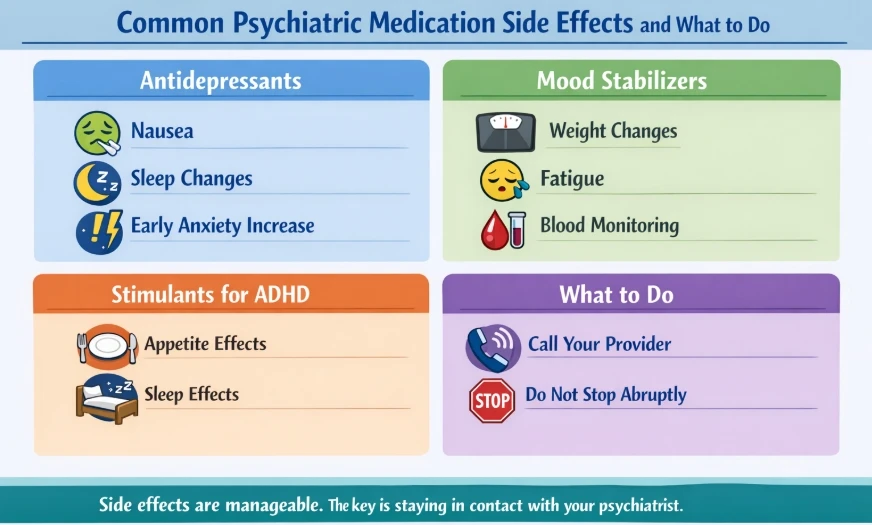
The most commonly reported side effects depend on the class of medication. Antidepressants, particularly SSRIs and SNRIs, can initially cause nausea, disrupted sleep, or increased anxiety before they start helping. Mood stabilizers can cause weight changes, fatigue, or in some cases requiring regular blood monitoring. Stimulants used for ADHD can affect appetite and sleep. Antipsychotics carry their own profile of potential effects.
What matters is that none of this is a reason to avoid medication if medication is what you need. It is a reason to be in regular contact with your prescriber so that if something feels wrong, it gets addressed quickly. The National Institute of Mental Health notes that side effects are often most pronounced in the first few weeks and tend to ease as your body adjusts.
Psychiatric medication side effects are manageable when you have a provider who is paying attention.
Medication Compliance Mental Health, Why People Stop Taking Their Medication
This is one of the most common and least talked about challenges in psychiatric care.
Medication compliance with mental health research consistently shows that a significant number of people stop taking their psychiatric medications within the first few months. The reasons vary. Side effects that were not explained in advance. A feeling that the medication is not working fast enough. Stigma around needing it in the first place. Feeling better and if it means medication is no longer necessary.
That last one is particularly common. Feeling better is often a sign that the medication is working, not that you no longer need it. Stopping abruptly without guidance from your psychiatrist can cause symptoms to return, sometimes harder than before.
If you are struggling with medication compliance, the right move is not to quietly stop. It is to call your provider and say exactly that. A good psychiatrist would rather hear that you are having doubts than find out three months later that you have been managing without support.
Therapy vs Medication for Anxiety, A More Honest Answer
The internet has a tendency to frame this as a debate. Medication versus therapy. Natural versus pharmaceuticals. Short-term fix versus real healing.
The framing is misleading and, in some cases, is genuinely harmful.
Therapy vs medication for anxiety is not a competition. Cognitive behavioral therapy, is one of the most effective treatments for anxiety disorders. So is medication for many people. The research does not say one is better than the other. It says that for a large portion of people, the combination outperforms either alone.
What the right approach looks like for you specifically depends on the type and severity of your anxiety, your history with previous treatments, your lifestyle, and your own preferences. That is a conversation worth having with a psychiatrist who has evaluated you not a conclusion to reach alone based on what you read online.

Child Psychiatry and Medication, What Parents Need to Know
For parents, the idea of psychiatric medication for a child can feel like one of the heaviest decisions they will ever make. That feeling makes complete sense. And it deserves a straightforward, honest answer rather than reassurance that glosses over the real questions.
Child psychiatry is a specialized field precisely because children are not just small adults. Their brains are still developing. Their bodies process medications differently. The way symptoms present in children often looks different from how the same condition is present in adults. A child who is struggling with inattention, impulsivity, emotional dysregulation, or persistent sadness needs a provider who understands that landscape specifically.
At Beautiful Minds, Dr. Humera Chowdhary and Dr. Naveed Khokhar are board-certified in both child and adolescent psychiatry and adult psychiatry, respectively, with a particular focus on every individual development. That specialization matters when you are making decisions about mental care.
Mood stabilizers for children and adults, when they are indicated, are used carefully and monitored closely. Conditions like pediatric bipolar disorder, severe ADHD, or early-onset mood disorders sometimes require medication as part of a broader treatment plan. According to the American Academy of Child and Adolescent Psychiatry, medication is most effective when combined with therapy and family involvement not used as a standalone fix.
FAQs
Psychiatric medication management is an ongoing process where a licensed psychiatrist monitors how your medication is working, adjusts dosages when needed, watches for side effects, and checks in overall functioning over time. It is not a one-time prescription. It is a structured, continuing relationship built around making sure the medication is actually doing what it is supposed to do for your specific situation.
No. In Texas, therapists including licensed counselors, psychologists, and social workers are not authorized to prescribe medication. Only psychiatrists, psychiatric nurse practitioners, and in some cases primary care physicians can prescribe psychiatric medication.
Call your provider. Do not stop taking the medication abruptly without guidance, as that can cause symptoms to return or worsen. Psychiatric medication side effects are often most pronounced in the first few weeks and can be managed with dosage adjustments or a medication change.
Yes, they can be safe when a child psychiatrist prescribes and monitors them carefully. At Beautiful Minds, we never jump straight to medication. A thorough evaluation always comes first. From there, any medication decision is part of a bigger plan that includes therapy and family involvement.
That depends on what you are dealing with, how long you have been dealing with it, and whether previous attempts at managing it on your own or through therapy alone have been enough. For many people, therapy vs medication for anxiety or depression is not a real choice; both are part of the answer.
When Medication Alone Is Not Enough
For some patients, standard psychiatric medications do not produce the relief they should. This is more common than most people realize, and it has a name: treatment-resistant depression or treatment-resistant anxiety.
If you or someone you care about has tried multiple medications without meaningful improvement, that is not a sign that nothing will ever work. It is a sign that the approach needs to shift.
At Beautiful Minds, options like TMS therapy and Spravato are available for patients who have not responded to standard treatments. TMS (transcranial magnetic stimulation) uses targeted magnetic pulses to stimulate areas of the brain involved in mood regulation, without the systemic side effects that come with medication. Spravato is an FDA-approved nasal spray treatment specifically designed for adults with treatment-resistant depression, administered in-office under medical supervision.
These are not last resorts. They are additional tools that a practice with the right expertise can offer when the standard path has not been enough.
If you are concerned about your or your child’s mental health and wondering whether psychiatry is the right next step, then Beautiful Minds Psychiatry in Texas is the place to start the psychiatric evaluation. Not a prescription. An evaluation first.
Disclaimer: This content is for informational and educational purposes only. It is not a substitute for professional mental health advice, diagnosis, or treatment. If you are in crisis, call or text 988 for the Suicide and Crisis Lifeline.