What to Expect When Starting Psychiatric Medication in Frisco

Most people who sit down with a psychiatrist for the first time and walk out with a prescription feel two things at once. Relief that something is finally happening, and a quiet nervousness about what that something is going to do to them. Both of those feelings make complete sense. Starting psychiatric medication is not a small decision, and anyone who tells you otherwise is not taking your experience seriously enough.
This blog is not going to tell you that medication fixes everything, or that the process is always smooth. What it will do is give you an honest picture of what the first few weeks actually look like, what to expect from your body, and what questions are worth asking before you fill that first prescription.
Key takeaway:
- What the first weeks on psychiatric medication feel like and why the timeline matters
- How SNRIs vs SSRIs differ, and which situations call for each
- What is SSRI activation syndrome, and why does it catch so many people off guard
- How psychiatric medication management works beyond just the initial prescription
- What tapering off antidepressants looks like when it is done the right way
- Where Frisco and DFW patients can find reliable ongoing medication support
What Nobody Tells You About the First Few Weeks on Medication
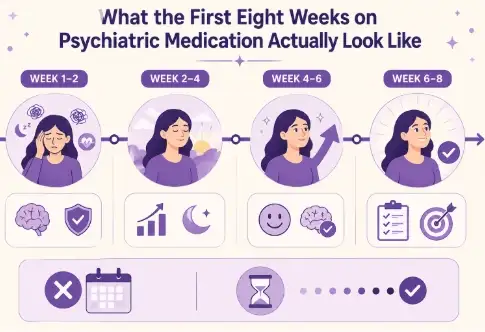
This is the single most important thing to understand before you start. Psychiatric medication does not work like painkillers. You do not take it and feel better that same afternoon. Most medications in this category need two to four weeks before you notice early changes, and the full effect often takes six to eight weeks to settle in properly.
That window feels long when you are already struggling. A lot of people stop during those early weeks because nothing seems to be happening, or because the first few days feel slightly worse than before. Stopping early is one of the most common reasons people decide medication does not work for them, when in reality, it never had enough time to do what it was supposed to do.
Psychiatric medication side effects tend to be most noticeable in the first one to two weeks and then ease off. Nausea, mild headaches, sleep changes, and a temporary increase in anxiety are all common during the startup period. None of them means the medication is wrong for you. They mean your brain and body are adjusting to something new, and that takes time.
The people who get the most out of their first medication experience are almost always the ones who knew what was coming before it arrived. That preparation makes a bigger difference than most people expect.
SNRIs vs SSRIs: What the Difference Actually Means for You
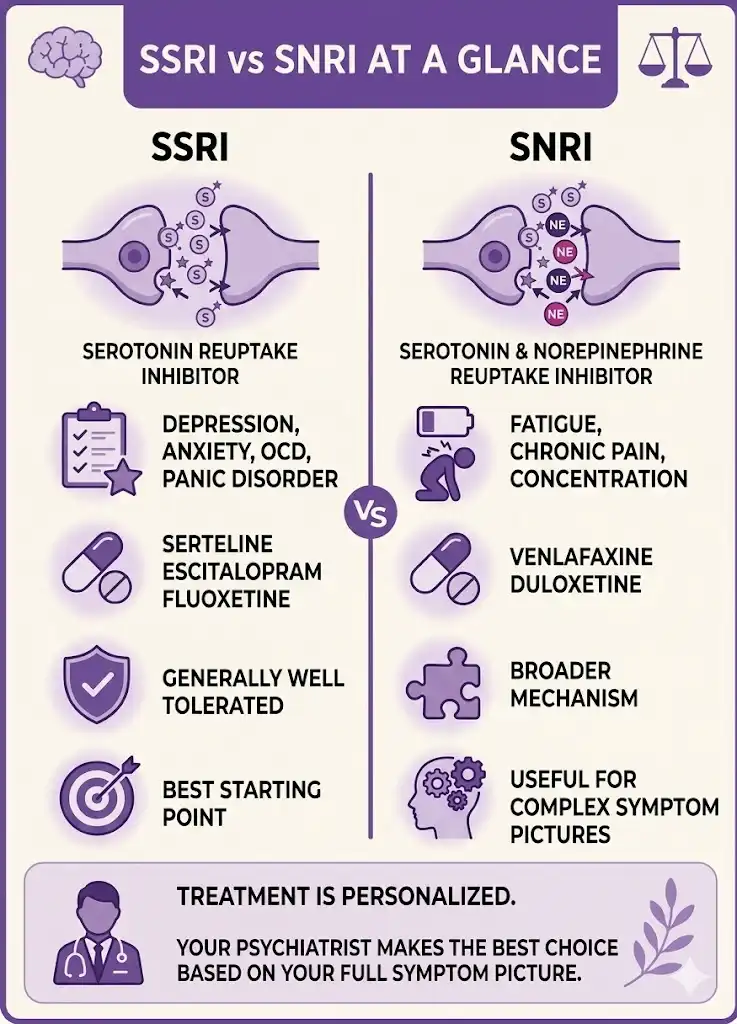
SSRIs vs SNRIs is a conversation that comes up early for most people starting psychiatric care, and understanding the basics helps you have a more useful conversation with your psychiatrist rather than just nodding along.
SSRIs work primarily by increasing serotonin availability in the brain. Medications like sertraline, escitalopram, and fluoxetine fall into this group. They are typically the first option tried for depression, generalized anxiety, social anxiety, OCD, and panic disorder because the evidence behind them is solid, and most people tolerate them reasonably well.
SNRIs for depression work on both serotonin and norepinephrine, which is why they often fit better for people who also deal with chronic pain, fatigue, or concentration difficulties alongside their mood symptoms. Venlafaxine and duloxetine are common examples that most people have heard of.
The choice between SNRIs vs SSRIs is not about one being stronger than the other. It is about which neurotransmitter picture fits your specific symptoms most closely. That is a conversation worth having in real detail with whoever is prescribing for you, not something to decide based on what worked for someone else.
What SSRI Activation Syndrome Actually Is
SSRI activation syndrome is something a significant number of patients experience in the first one to two weeks of starting a new medication, and almost nobody warns them about it ahead of time.
It shows up as a temporary increase in anxiety, restlessness, irritability, and sometimes disrupted sleep right after starting. For someone who already deals with anxiety, those first few days can feel genuinely alarming. The instinct is usually to assume the medication is making things worse and to stop taking it.
SSRI activation syndrome is not a sign that the medication is wrong for you. It is a known, temporary response that tends to settle within one to two weeks as your brain adjusts to the change. Knowing it is coming before it arrives makes a real difference in whether people stay in the course during that window or give up too early.
If symptoms feel genuinely severe during that period, talk to your psychiatrist. That is very different from stopping on your own without any guidance.
Psychiatric Medication Management Is Not a Set and Forget Process
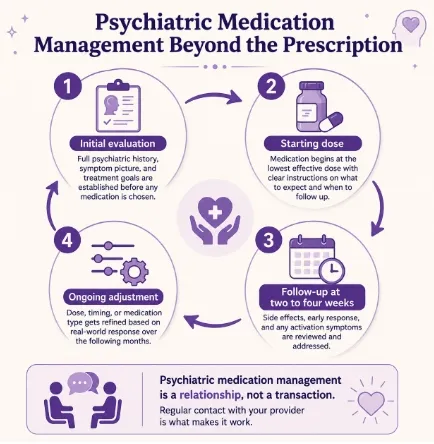
One of the biggest misunderstandings about starting medication is that getting a prescription is the finish line. It is actually the starting line. Psychiatric medication management is an ongoing process that involves regular follow-ups, honest conversations about how you are responding, and real adjustments along the way.
Your first dose is rarely your final dose. The medication that works well at month one might need adjusting at month three. A completely different medication might serve you better once your psychiatrist has more information about how your brain actually responds. Psychiatrist medication management done well looks like a real working relationship, not a once-a-year refill conversation where nothing gets examined.
This matters even more for more complex situations. Lamictal for bipolar disorder, for example, requires a careful titration process where the dose increases slowly over several weeks to reduce the risk of a rare but serious skin reaction. That process cannot be rushed. It needs a prescribing provider who is genuinely paying attention at every stage, not just checking out a box.
Vyvanse for ADHD works differently than most medications. When you take it matters. How it affects your appetite and sleep matters just as much. Your provider needs real feedback from you to figure out what adjustments to make.Getting that feedback requires consistent contact, not just an annual appointment that covers nothing in depth.
What Nobody Tells You About Longterm Antidepressant Use
Long term antidepressant use is one of the topics patients are often nervous to bring up because they are not sure what the answer will be. The honest answer is that for many people, staying on medication long term is a completely reasonable and well-supported clinical choice.
Depression and anxiety are not always short-term conditions. For people who have had multiple episodes or whose symptoms return every time they try to stop, staying on medication is not dependency or weakness. It is a decision made in partnership with a provider who knows your history well enough to make that call with you.
That said, some people do successfully come off medication after a sustained period of stability. Tapering off antidepressants is not the same as stopping cold turkey, and that difference matters more than most people realize. Stopping abruptly can trigger antidepressant discontinuation syndrome, which involves dizziness, flu-like feelings, mood shifts, and what a lot of people describe as brain zaps. Going slowly with proper medical guidance prevents most of that from happening.
The decision about whether and when to taper is one that belongs between you and your psychiatrist. It is not something to decide on your own because you are feeling better and think you probably do not need it anymore.
What to Tell Your Psychiatrist at Every Appointment
Knowing what to tell your psychiatrist is something people underestimate. A lot of patients sit down and say they are fine or not fine without giving their provider the specific detail that actually changes the direction of care.
Be honest about your sleep. Mention if your appetite has changed, even slightly. Feeling emotionally flat is worth bringing up, even when the sadness is gone. Big changes at work or in your relationship matter too. Skipping a dose or taking it at a different time is something your provider needs to know. All that information shapes what your provider decides to do next and leaving it out slows down your progress more than most people realize.
Good psychiatric medication management depends on your provider having the real picture, not a polished version of it.
Getting Support Through an Online Psychiatrist Texas
Access to psychiatric medication management has changed significantly with telehealth. An online psychiatrist Texas patients can connect with through Beautiful Minds means that starting medication, managing follow-ups, and adjusting doses no longer requires taking half a day off work or sitting in traffic.
For patients in Frisco, Plano, McKinney, and the wider DFW area, telehealth psychiatric care offers the same quality of medication management as in-person visits with significantly less friction. Initial evaluations, prescription management, and regular follow-ups can all happen virtually, which removes one of the most common reasons people put off getting help in the first place.
Frequently Asked Questions
Psychiatric medication management involves prescribing, monitoring, and adjusting medications to treat mental health conditions safely and effectively.
Lamictal for bipolar disorder prevents mood episodes rather than just treating them after they arrive, particularly on the depressive side. It stabilizes mood without heavy sedation, which is a big reason psychiatrists reach for it over other options.
For most people, no. Long-term antidepressant use is well-tolerated when a psychiatrist is actually monitoring it regularly. Some people notice weight or sleep changes over time, but permanent effects are not common with proper ongoing care.
Neither is better across the board. SNRIs vs SSRIs comes down to your specific symptoms. When fatigue, concentration problems, or chronic pain sit alongside depression, SNRIs for depression often fit better. SSRIs are usually tried first because they work well for most people. Your psychiatrist steers that decision based on your full picture.
It depends entirely on your history. Some people taper off psychiatric medication after a stable period. Others need to stay on it long term because symptoms return every time they stop. That decision belongs between you and your psychiatrist, not something to work out on your own.
Getting Evaluated at Beautiful Minds Psychiatry
Beautiful Minds Psychiatry in Frisco works with people who are starting psychiatric medication for the first time. Some patients come in after switching from something that stopped working. Others just want someone to explain their treatment plan in plain language, finally.
Before any medication gets prescribed, every patient goes through a thorough evaluation. Your symptoms matter. So does your history, your lifestyle, and what you actually want out of treatment. A fifteen-minute intake and a standard prescription is not how things work here.
Both telehealth and in-person appointments are available. If you are in the Frisco or greater DFW area and ready to have an honest conversation about what medication can and cannot do for you, Beautiful Minds is the right place to start.
Disclaimer: This content is for informational and educational purposes only. It is not a substitute for professional mental health advice, diagnosis, or treatment. If you are in crisis, call or text 988 for the Suicide and Crisis Lifeline.