Is TMS Covered by Insurance in Texas? What Frisco Patients Need to Know in 2026

If you have been looking into TMS therapy and the first thing you hit is a wall of insurance questions, you are not alone. Most people who reach out about TMS services are not asking whether it works. They already know it works. What they are asking is whether is TMS covered by insurance in their specific situation, what the process looks like, and whether the whole thing is going to be worth pursuing or just another dead end.
This blog answers those questions directly, without the runaround.
Key Takeaway:
- Whether is TMS covered by insurance in Texas and what criteria matter
- What TMS FDA approval means for your coverage eligibility
- How TMS insurance coverage compares to Spravato insurance coverage and ketamine therapy insurance
- What TMS cost without insurance looks like and what financing options exist
- Whether does Medicare cover TMS and what that process involves
- How much does TMS cost and what affects that number in 2026
Is TMS Covered by Insurance in Texas?
The short answer is yes, for most people who meet the criteria. TMS insurance coverage has come a long way as the clinical evidence grew stronger and more insurers updated their policies to keep up with it.
Most major commercial insurance plans in Texas, like Blue Cross Blue Shield, Aetna, United Healthcare, Cigna, and Humana, cover TMS therapy for major depressive disorder as long as you meet their criteria.
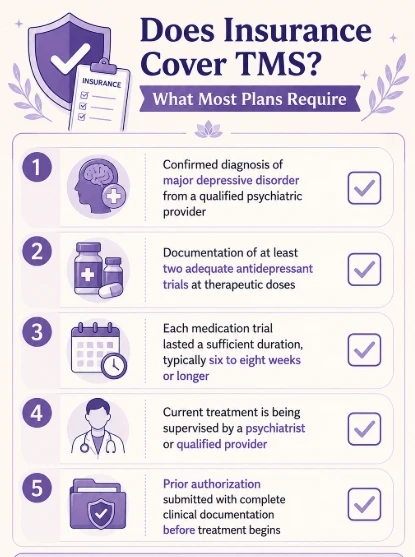
Insurers usually look for a few specific things. A confirmed diagnosis of major depressive disorder comes first. You also need a documented history of trying at least two antidepressants at the right doses for long enough without getting real relief. Plus, a qualified psychiatric provider needs to be supervising your current treatment.
TMS insurance coverage does not happen automatically. It requires a prior authorization process, which your provider’s office should manage on your behalf. Bring a clear medication history, including what worked and what didn’t. The more thorough that documentation is, the smoother the authorization tends to go.
TMS FDA Approval and Why It Matters for Coverage
TMS FDA approval is tied to how insurers justify covering the treatment. The FDA first cleared TMS for major depressive disorder in 2008 with the NeuroStar system, and later cleared it for OCD through the Brainsway deep TMS system and for smoking cessation.
TMS FDA approval for a specific condition is what gives insurers the clinical foundation to cover it. When you ask about TMS therapy insurance for depression, the insurer checks three things. Does the treatment have FDA clearance for your specific diagnosis? Do you meet the diagnostic criteria? Have you already gone through the step therapy requirements?
Patients seeking TMS for conditions like anxiety or PTSD sometimes run into more pushback from insurers, even when the clinical evidence is solid. FDA clearance is what reliably opens the insurance door, and knowing that going in helps you set realistic expectations during the authorization process.
Does Medicare Cover TMS?
Does Medicare cover TMS is one of the most common questions providers hear from patients over 65 or patients with disability who rely on Medicare for their coverage.
The answer is yes, Medicare does cover TMS therapy for major depressive disorder, and it has since 2020 when Medicare established a national coverage determination for the treatment. Medicare covers TMS as a non-drug treatment for patients with major depressive disorders who have not responded adequately to antidepressant therapy.
The requirements under Medicare mirror those of most commercial plans. You need a confirmed diagnosis, documented antidepressant treatment history, and a treating psychiatrist who manages the overall care.
Medicare Advantage plans follow their own policies which can vary, so verifying coverage details with your specific plan before starting is worth doing rather than assuming the standard Medicare determination applies automatically.
Spravato Insurance Coverage and Ketamine Therapy Insurance
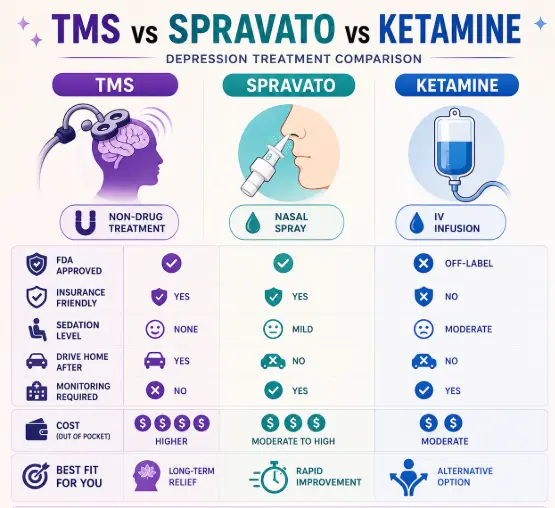
Patients exploring treatment resistant depression often ask how TMS, Spravato, and ketamine compare on insurance coverage. Most major commercial plans and Medicare cover both TMS and Spravato, as long as you show documented proof that antidepressant trials failed. Ketamine is a different story.
IV ketamine infusions are the most common form but lack FDA approval for depression, so most insurers won’t cover them, leaving patients paying 400 to 800 dollars per infusion out of pocket. Spravato, the nasal spray form of ketamine, does carry FDA approval, which is exactly why insurance covers it when standard ketamine therapy falls short.
For most patients with treatment resistant depression, TMS holds a stronger insurance position than IV ketamine and sits roughly on par with Spravato.
TMS Cost Without Insurance
For patients who are uninsured, underinsured, or just got a denial, TMS cost without insurance becomes the only number that actually matters.
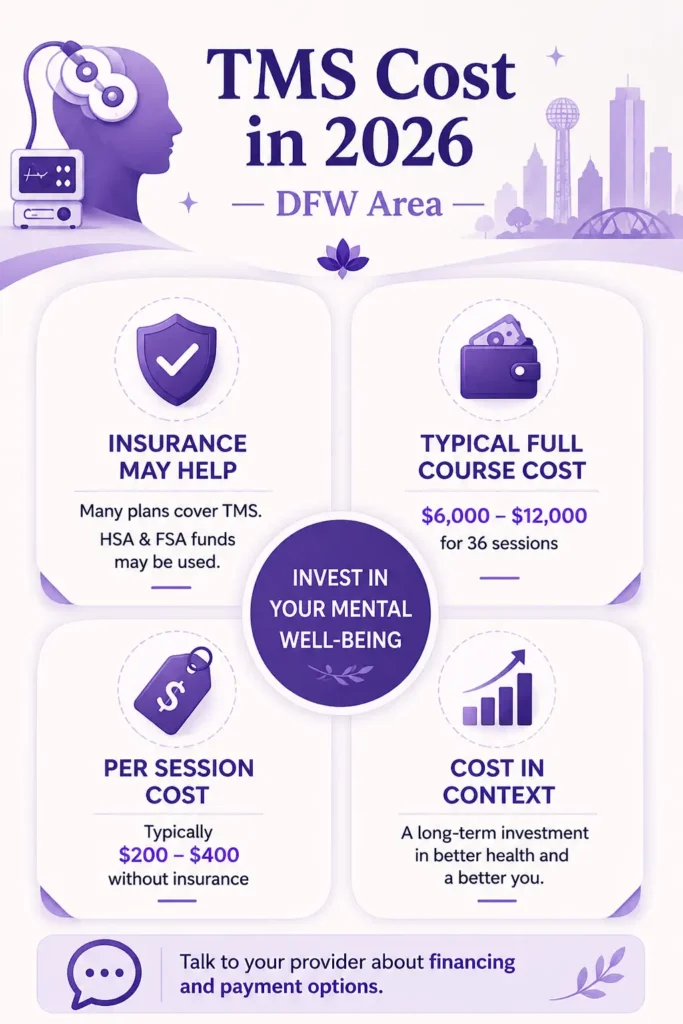
How much does TMS cost when you are paying out of pocket varies by provider and by the specific protocol used. A full standard course of TMS, typically 36 sessions over six to seven weeks, runs between 6,000 and 12,000 dollars at most practices in the DFW area. Some practices offer financing through third-party healthcare lenders, and a few offer sliding scale or reduced rates in specific circumstances.
TMS cost without insurance is significant but worth putting in context. A course of TMS is a one-time expense for a treatment that produces lasting results for many patients. Repeated psychiatric hospitalizations, ongoing medication costs that are not producing results, and the indirect costs of untreated depression on work and daily functioning often exceed the cost of TMS over time.
If you are facing TMS cost without insurance as your reality, asking your provider directly about financing options, payment plans, and whether any patient assistance pathways exist is worth doing before assuming it is out of reach.
What Happens if Your TMS Insurance Authorization Is Denied
Insurance denials for TMS therapy Insurance is not the end of the road, and it is important to understand that before you give up.
Denials usually come down to a few things, like incomplete documentation, not fully meeting the step therapy requirements, or the specific protocol you requested simply not being covered under your plan. All of these are appealing.
Your provider’s office should handle the appeal process, which typically involves submitting additional clinical documentation, requesting a peer-to-peer review where your psychiatrist speaks directly with the insurance company’s medical reviewer, and in some cases pursuing an external review through the Texas Department of Insurance if the internal appeal is unsuccessful.
A denial is a step in a process, not a final answer. Practices that offer TMS regularly have experience navigating this process, and their involvement significantly improves appeal outcomes compared to patients trying to manage it alone.
Frequently Asked Questions
Yes, insurance often covers TMS therapy sessions, but it really comes down to your specific plan and whether the treatment is medically necessary. Most providers want TMS recommended for a diagnosed condition like depression, and they also want proof that you have already tried other treatments first. Some plans may also require prior authorization before treatment begins.
Most authorizations come back within two to four weeks of submission, though some insurers take longer, and others move faster. Your provider’s office handles the submission and should follow up on your behalf.
Yes. TMS therapy is a qualified medical expense and is eligible for payment through both health savings accounts and flexible spending accounts. If you are managing TMS cost without insurance or covering a deductible or copay, using pre-tax HSA or FSA funds reduces the effective out of pocket cost meaningfully.
When you call, ask whether TMS is covered for your specific diagnosis, what step therapy requirements you need to meet, how many sessions your plan covers per course, whether you need a prior authorization and how long that takes, and finally what you will actually owe out of pocket, counting your deductible, copay, and coinsurance.
Getting Evaluated at Beautiful Minds
Beautiful Minds Psychiatry in Frisco offers TMS services as part of a comprehensive psychiatric care model, which means insurance navigation is part of what the practice handles alongside the clinical work.
The team manages prior authorization, works through documentation requirements, and stays involved throughout the approval process, so patients are not left figuring out the insurance side on their own. Both telehealth and in-person consultations are available, making it easy to get an evaluation and understand your coverage situation before committing anything.
If you live in Frisco, Plano, McKinney, or anywhere in the wider DFW area and want a straight answer about whether your specific plan covers TMS in 2026, Beautiful Minds is the right place to start.
Disclaimer: This content is for informational and educational purposes only. It is not a substitute for professional mental health advice, diagnosis, or treatment. If you are in crisis, call or text 988 for the Suicide and Crisis Lifeline.